December 2025 Performance Synopsis
December ended with a clear takeaway for thematic investors: dispersion was the defining feature. Performance differentials widened significantly across portfolios, led by a near +18% surge in Cannabis & Psychedelics, alongside strength in space infrastructure and other commodity-linked themes. Industrial metals remained resilient, while growth-focused areas—including technology, healthcare, consumer discretionary, real estate, and digital assets—underperformed as investor appetite continued to shift toward cyclical and hard-asset exposures.
Best Performing Themes
Cannabis & Psychedelics +17.95%
Federal Rescheduling of Marijuana: Trump announced an executive order reclassifying marijuana from Schedule I to Schedule III, dramatically easing federal restrictions and legitimising the cannabis industry. This represents the most significant federal cannabis policy reform in decades, improving legal status, banking access, and tax treatment for cannabis companies. [1, 4, 5]
Regulatory Momentum and Political Support: The Trump administration's vocal support for cannabis reform and willingness to act quickly ("possibly as soon as next week") created strong positive sentiment that the industry would see continued favourable regulatory changes, reducing legal and operational risks. [1, 2, 3]
Medical Legitimacy: Ongoing research and discussions about cannabis for chronic pain treatment and other medical applications reinforced the therapeutic value proposition of cannabis products, supporting the industry's transition from recreational to medically-accepted treatments. [6]
Aerospace & Science Satellites +17.17%
Operational Risks and Safety Concerns: Multiple near-collisions, satellite anomalies, and debris events highlighted growing operational risks in increasingly congested LEO environment, potentially raising insurance costs and regulatory scrutiny while demonstrating resilience of satellite operators. [32]
Megaconstellation Expansion and Competition: Aggressive deployment of Starlink satellites (multiple launches throughout December) alongside competitive threats from AST SpaceMobile's massive BlueBird 6 and Amazon's Project Kuiper demonstrated robust market growth and intensifying competition in satellite broadband sector. [19, 20, 25, 34]
Regulatory and Environmental Pressures: Studies showing satellites interfering with space telescopes, shortened collision avoidance windows, and potential regulatory restrictions by late 2030s created uncertainty but also validated the strategic importance of first-mover advantage in LEO. [8, 12, 14]
Emerging Commercial Applications: New opportunities in space-based data centres, AI infrastructure, and satellite servicing demonstrated market diversification beyond traditional communications, potentially expanding total addressable market for aerospace companies. [7, 10, 17]
Technological Competition and Launch Cadence: China's reusable rocket tests and record launch rates, alongside SpaceX's operational tempo, showcased intensifying global competition in launch services and reusable rocket technology, affecting market positioning of aerospace companies. [9, 13, 15, 16]
Space Exploration +13.64%
SpaceX Valuation Surge and IPO Plans: SpaceX doubled in value and is reportedly planning a blockbuster $1.5 trillion valuation IPO in 2026, with plans to raise over $25 billion. Starlink traffic doubled in 2025, demonstrating strong business fundamentals. [25, 26, 27, 28, 29]
Infrastructure Expansion and Operational Growth: SpaceX received approval to build two additional Starship launch pads at Cape Canaveral, expanding launch capabilities. This infrastructure development signals confidence in future launch demand and commercial opportunities. [22]
Pro-Commercial Space NASA Leadership: The Senate confirmation of billionaire Jared Isaacman as NASA administrator represents a significant positive for commercial space companies. Isaacman is a SpaceX customer and advocate, likely to accelerate public-private partnerships and commercial space initiatives. [21, 23, 24]
Operational Challenges Balanced by Growth: While SpaceX experienced setbacks including a Starlink satellite explosion and near-collision incident, these were offset by the company's overall momentum, strong traffic growth, and expanding market position. [19, 20]
Telecommunications Satellites +12.52%
SpaceX IPO Momentum and Valuation Surge: SpaceX's preparation for a blockbuster 2026 IPO targeting $25+ billion in capital raise at valuations ranging from $800 billion to $1.5 trillion demonstrates exceptional investor confidence in the satellite communications sector. The IPO is driven primarily by Starlink's rapid expansion, including direct-to-mobile services and doubling traffic volumes. [25, 29, 30, 33, 39, 40, 44, 46]
Starlink Business Expansion and Market Penetration: Starlink traffic doubled in 2025, the company opened its first retail stores, and expanded service offerings, indicating strong revenue growth and market adoption. This operational success validates the satellite internet business model and demonstrates the commercial viability of LEO megaconstellations. [25, 35, 38]
Growing Satellite Constellation Ecosystem: Multiple companies including Amazon and partnerships like Globalstar-Apple are expanding satellite communications capabilities, showing sector-wide growth beyond just SpaceX. This diversification and competition validates the market opportunity and drives overall sector performance. [36, 42, 43, 45]
Operational Maturity Despite Challenges: While near-collisions and satellite anomalies highlight operational risks in increasingly congested LEO space, the sector's ability to manage thousands of satellites and reduce collision avoidance timeframes demonstrates operational sophistication and infrastructure maturity that supports continued investment. [20, 31, 32, 34, 37, 41]
Nickel +11.57%
Deep-Sea Mining Regulatory Developments: Growing concerns about environmental impact of deep-sea mining for polymetallic nodules (which contain nickel) may have tightened supply expectations. Studies showing significant ecosystem damage and opposition from UN, scientists, and Indigenous peoples could limit future supply growth, supporting higher prices. [48, 49, 51, 52]
Critical Minerals Policy Focus: The US administration's increased focus on securing critical mineral supplies, including nickel, likely boosted demand expectations. Policy changes prioritising domestic supply chains and strategic mineral stockpiling would support price appreciation. [47, 50]
Supply Constraints from Environmental Opposition: Scientific evidence of deep-sea mining's environmental damage (37% decline in seabed animals from test mining) strengthened the case against new nickel supply sources, potentially tightening medium-term supply outlook and supporting December price gains. [49, 52]
Worst Performing Themes
Cryptocurrency & Digital Assets -13.18%
Regulatory Crackdowns and Bans: China implemented its biggest crypto crackdown since 2021, banning RWA tokenisation, while investigations revealed widespread use of cryptocurrencies for money laundering and sanctions evasion, triggering fears of broader regulatory action globally. [53, 54, 56]
Security Breaches and Criminal Activity: Record-breaking cryptocurrency thefts totalling over $2 billion by North Korea, combined with widespread scams including Coinbase phishing attacks and darknet market activity on Telegram, severely damaged investor confidence in crypto security and legitimacy. [53, 55, 57, 58]
Technical Price Weakness and Bearish Sentiment: Bitcoin crashed 32% in December with analysts predicting further drops to $60,000, showing "lack of conviction" among investors. Major cryptocurrencies failed to rally even with positive catalysts like Fed rate cuts, indicating fundamental weakness in the market. [59, 62, 71, 72, 73, 137]
Negative Sentiment from Influential Figures: High-profile skepticism from investors like Michael Burry calling Bitcoin "worthless" and structural concerns about crypto's value proposition contributed to declining confidence and selling pressure across digital assets. [59, 60]
Blockchain & Distributed Ledger Technology -11.36%
Regulatory Crackdowns and Criminal Activity: Multiple high-profile scams, fraud cases, and criminal use of cryptocurrencies undermined market legitimacy. China implemented its biggest crypto crackdown since 2021 with RWA tokenisation bans, while investigations revealed stablecoins facilitating money laundering and sanctions evasion. North Korea's record $2B+ in crypto theft highlighted persistent security vulnerabilities. [53, 54, 55, 57, 58]
Severe Price Deterioration and Technical Breakdown: Bitcoin experienced a 32% crash in December, breaking typical seasonal patterns, with prices dropping to $86,000 and risks of further decline to $60,000. The market showed "lack of conviction" with sharp intraday drops ($2,000 in 35 minutes) triggering $132M in liquidations. Bitcoin fell 30%+ from all-time highs despite traditionally positive catalysts like Fed rate cuts. [63, 65, 68, 70, 73]
Loss of Institutional and Investor Confidence: Influential figures like Michael Burry called Bitcoin "worthless," while precious metals outperformed crypto as investors fled to traditional safe havens. Japanese investors exited crypto markets, and digital asset treasury companies like MicroStrategy faced pressure. XRP remained down 49% despite ETF inflows, indicating broader weakness beyond individual tokens. [59, 62, 64, 66, 69, 71]
Weakening Fundamentals and Market Structure: Bitcoin mining profitability declined as miners pivoted to AI, suggesting deteriorating economics. Market manipulation concerns emerged around November's crash, while macroeconomic headwinds from Japan's potential rate decisions threatened liquidity. The decoupling of crypto from traditional positive catalysts indicated fundamental weakness rather than temporary correction. [60, 61, 67]
Toys & Games -7.71%
Safety Concerns with AI-Powered Toys: Recalls and disturbing content from AI-enabled children's toys created significant safety and trust issues, likely causing parents to avoid smart toys during the critical holiday shopping season. [74, 78]
Severe Gaming Hardware Sales Decline: Video game hardware spending dropped 27% year-over-year in November to historically low levels ($695M, lowest since 2006's $455M), indicating widespread weakness in gaming console and hardware sales during the peak holiday shopping period. [83]
Industry Distress Signals: Multiple indicators of gaming industry challenges including company shutdowns (Arcade1Up), product discontinuations (LCD Steam Deck), security breaches (Rainbow Six Siege), and extended promotional pricing on major platforms (PlayStation, Xbox) suggest broad-based weakness in the toys and games sector. [77, 79, 80, 81, 82]
Weakening Consumer Enthusiasm: Declining interest in major gaming events (Game Awards losing luster) and continued price increases amid layoffs suggest reduced consumer engagement and spending appetite in the gaming sector during December. [75, 76]
Taxis & Ride-Hailing -6.60%
Autonomous Vehicle Operational Failures: Waymo robotaxis experienced multiple high-profile failures during a San Francisco power outage, becoming stranded in intersections and requiring manual intervention to close doors. These incidents raised serious questions about the reliability and scalability of autonomous ride-hailing services, potentially dampening investor enthusiasm for the sector. [84, 87, 89, 92, 94, 95]
Intensifying Competition from Robotaxi Services: Tesla registered over 1,000 vehicles for its robotaxi fleet in California, Rivian announced major autonomous driving initiatives with hints at ride-hailing entry, and multiple reports highlighted robotaxi expansion across US cities. This surge in autonomous vehicle competition threatens traditional ride-hailing companies' market share and pricing power. [86, 88, 90, 93, 96]
Regulatory and Legal Pressures: The FTC lawsuit against Uber, joined by 21 states and DC over subscription practices, represents significant legal risk and potential financial penalties. Additionally, California regulators began reviewing Waymo's operational failures, suggesting increased regulatory scrutiny across the ride-hailing sector. [85, 94]
Market Penetration Concerns: Uber's CFO revealed that only 15% of US adults use its services, indicating limited market penetration despite years of operation and suggesting potential growth challenges and market saturation that may have concerned investors about future revenue growth prospects. [91]
Biofuels -6.28%
EU Policy Reversal on ICE Ban: The European Union significantly weakened its 2035 ban on internal combustion engines, reducing required emissions cuts from 100% to 90% and explicitly allowing hybrids and biofuels to continue. This major policy shift reduces the urgency and long-term demand outlook for biofuels as transportation alternatives, undermining investor confidence in the sector's growth trajectory. [97, 98, 99, 101, 102, 103, 104, 109, 110, 111]
Aviation Biofuel (SAF) Mandate Challenges: Airlines warned that Europe's Sustainable Aviation Fuel mandates are "falling apart" and driving up costs rather than enabling progress, with climate goals potentially out of reach. This signals implementation difficulties and cost pressures in a key growth market for biofuels, dampening sector prospects. [105, 106, 107, 108]
Biofuel Producer Financial Stress: German biofuel company Verbio reported losses for the year despite optimistic outlook, indicating current profitability challenges in the sector. Combined with record ethanol production but weakening corn prices, this suggests oversupply conditions and margin pressure for biofuel producers. [100, 112, 113]
Feedstock Price Weakness: Sugar prices declined due to increased supply from India and Brazilian real weakness, while corn prices gave back gains despite record ethanol production. Lower feedstock prices can squeeze biofuel producer margins when output prices don't adjust proportionally, particularly in oversupplied markets. [114, 115, 116, 112, 113]
Cross-Month Comparison
In December, the previous month’s laggard - Cannabis & Psychedelics - staged a dramatic rebound to lead all themes, while Space Exploration and Aerospace & Science Satellites recovered strongly after November losses. Law Enforcement also reversed course, posting notable gains. Conversely, November leaders such as Weight Loss & Diabetes retraced nearly all their prior gains, and defensive healthcare and energy themes continued to underperform, highlighting broad-based sector rotation and shifting investor sentiment.
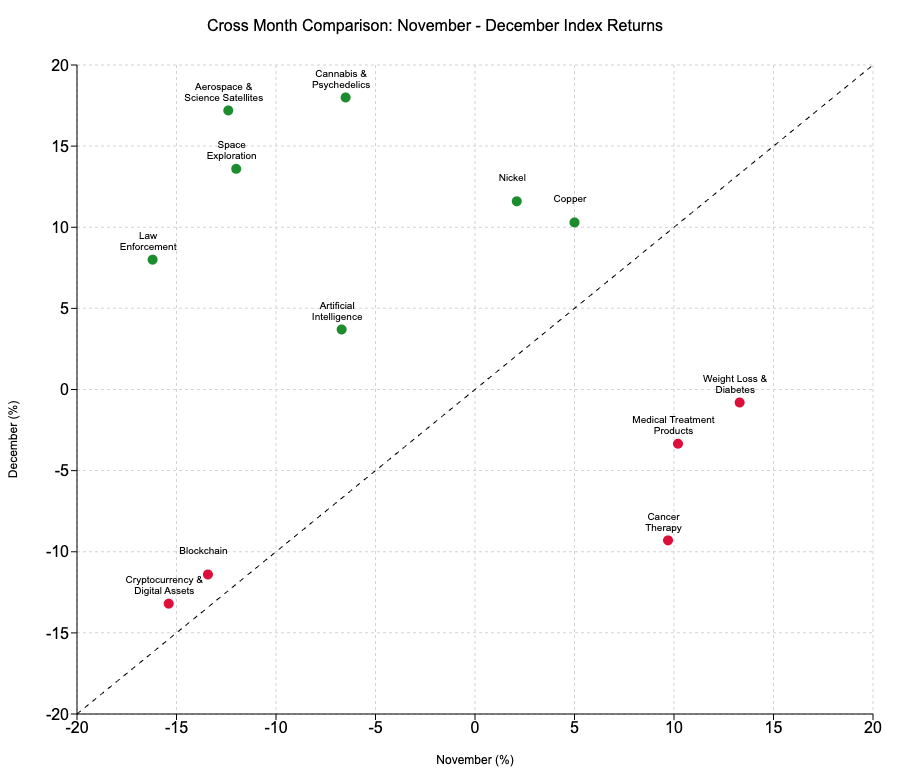
Interesting Themes from Cross-Month Comparison
Law Enforcement Nov -16.19% → Dec +7.99%
Major Security Incidents and Policy Response: The Bondi Beach terrorist attack in Australia (killing 12 people) triggered immediate government response including intelligence reviews and fast-tracked gun/protest laws, signalling potential increased investment in law enforcement capabilities and security infrastructure. This type of high-profile incident typically drives positive sentiment for law enforcement and security sector stocks. [120, 121, 122, 123, 124, 125]
Expansion of Surveillance Technology: Multiple reports highlighted law enforcement agencies expanding surveillance capabilities, including Border Patrol's standardisation of small drone technology and Europol's focus on AI/robotics for policing. This indicates growing technology procurement budgets and modernisation efforts that benefit law enforcement technology providers. [117, 118, 119]
Heightened Geopolitical Security Concerns: The MI6 chief's warning about Russia posing an "acute threat" and Australia's intelligence review point to an elevated threat environment requiring enhanced security measures. This geopolitical tension typically supports increased defence and law enforcement spending, creating a more favourable environment for the sector in December compared to November's decline. [122, 126]
Weight Loss & Diabetes Nov +13.25% → Dec +0.78%
FDA Approval of Oral Wegovy Created Competitive Pressure: The December FDA approval of Novo Nordisk's oral Wegovy pill represented a major product innovation that could shift market dynamics, potentially creating headwinds for competing weight loss and diabetes treatments. The extensive media coverage and market attention to this milestone likely created uncertainty about competitive positioning for other players in the space. [124, 125]
Increased Competition in GLP-1 Market: The launch of Cipla's tirzepatide (Yurpeak) in India through collaboration with Eli Lilly, combined with continued development by companies like Viking Therapeutics, intensified the competitive landscape. This growing competition may have pressured valuations across the weight loss/diabetes sector. [127, 129]
Market Consolidation Around Established Players: The significant regulatory win for Novo Nordisk's oral formulation, combined with expanding clinical evidence for semaglutide applications (including PCOS treatment), may have led investors to favour established GLP-1 leaders over smaller competitors, creating downward pressure on the broader theme. [129, 130]
Artificial Intelligence Nov -6.69% → Dec +3.71%
Major Product Launches and Competitive Advances: OpenAI's release of GPT-5.2 as their "best model yet" and Google's Gemini Live upgrades demonstrate accelerating innovation and product improvements, likely boosting investor confidence in AI capabilities and commercial viability after November's decline. [131, 135, 139]
Strategic Partnerships and Enterprise Adoption: The $1 billion Disney-OpenAI partnership and Adobe-ChatGPT integration signal growing enterprise adoption and monetisation opportunities, suggesting AI is moving beyond hype into practical business applications that generate revenue. [136, 138]
AI Infrastructure Consolidation: Intel's move to acquire chip startup SambaNova indicates strategic consolidation in AI infrastructure, suggesting maturation of the sector and confidence in long-term growth prospects, which typically supports positive market sentiment. [134]
Market Expansion Beyond Core Tech: AI expansion into new sectors like automotive (Rivian's self-driving initiative) and gaming (Tencent's 3D models) demonstrates broadening market opportunities beyond traditional tech applications, potentially expanding addressable markets for AI companies. [132, 140]
Ecosystem Development: OpenAI's App Directory launch and industry collaboration on AI agent standards show maturing market infrastructure and platform effects that could drive sustained growth, helping reverse November's negative sentiment. [133, 137]
Region Best and Worst Performing Themes
Silver APAC-ex-CN +17.33% vs EMEA +16.50%
Historic Rally in Precious Metals: Silver experienced an extraordinary 150% rally in 2025, outperforming gold's 64% gain and marking the best year for precious metals since 1979. This parabolic move was driven by multiple factors including industrial demand and supply constraints. [141, 143, 145, 147]
Weak Dollar Environment: The declining U.S. dollar supported precious metals demand by making gold and silver cheaper for overseas buyers, particularly benefiting APAC and EMEA regions where silver saw 17.33% and 16.50% returns respectively. [142, 149]
Industrial and EV Demand: Silver's outperformance was fuelled by increasing demand from electric vehicle manufacturing and defence spending, coupled with supply deficits that created a fundamental supply-demand imbalance favouring higher prices. [141, 144]
Shift from Traditional Assets: Analysts declared the "king dollar is dead" and precious metals bulls taunted cryptocurrency investors, suggesting a rotation of capital from digital assets and traditional currencies into tangible precious metals as safe-haven and inflation hedges. [62, 142, 148]
Momentum and Speculative Interest: Veteran investors targeting $300 silver in a coming "mania" phase, combined with silver becoming one of the hottest trades of 2025, attracted significant speculative capital and momentum-driven buying. [146, 148]
Copper: APAC-ex-CN +14.38% vs EMEA +12.19%
AI Infrastructure Buildout: Massive data centre construction for AI applications requires extensive copper wiring for power distribution and cooling systems, driving industrial demand in both APAC and EMEA regions [153]
Chinese Export Policy and Supply Chain Dynamics: China's streamlined export licences for magnet products and rare earth processing indicate evolving trade policies affecting copper-intensive manufacturing and electronics supply chains [47, 150]
Trade Policy Uncertainty: Trump's global tariff wars created volatility in manufacturing and construction sectors, but also potential for supply chain restructuring that could benefit copper demand in certain regions [152]
Geopolitical Stability in Resource-Rich Regions: Peace initiatives in copper-producing regions like DR Congo and geopolitical shifts in Latin America affected supply expectations and mining operations [154, 155]
Commodity Super Cycle Momentum: Broader strength in precious metals and mining sector sentiment created positive spillover effects for industrial metals including copper [141, 143, 151]
Cables & Wires CN +25.26%
Data Centre Expansion Driving Infrastructure Demand: The explosive growth of AI-powered data centres created unprecedented demand for electrical infrastructure, with projections showing data centres will require 1.1 million tonnes of copper annually by 2030 (3% of global demand). Federal regulators approved direct connections between data centres and power plants, while utilities like Georgia Power planned $15+ billion investments to meet this demand. [156, 159, 163, 164, 166, 168]
Grid Modernisation and Capacity Expansion: Surging electricity demand growing faster than in decades exposed grid inefficiencies and bottlenecks, driving investments in grid technology and transmission infrastructure. Grid tech stocks were positioned to soar as utilities scrambled to upgrade aging infrastructure to handle AI and data centre loads. [160, 162, 165, 167, 169]
Copper and Cable Demand from Tech Infrastructure: The semiconductor industry's positioning for 2026 growth, combined with specialised chip manufacturing requirements and data centre buildouts, created substantial demand for copper cabling, fiber optics, and electrical wiring systems essential for connecting next-generation computing infrastructure. [157, 158, 161, 164]
Optical Communications & Optoelectronics CN +21.87%
AI Data Centre Optical Infrastructure Boom: Explosive growth in AI data centres driving unprecedented demand for high-speed optical networking components, with 800G+ optical transceiver modules projected to reach 63 million units by 2026 (2.6x growth). This infrastructure buildout is generating record revenues for optical communications companies. [177, 180]
Critical Component Supply Constraints: NVIDIA and major tech companies aggressively securing laser and optical component production capacity, creating global shortages that are driving valuations higher. Supply-demand imbalances in essential optical components like EML lasers are forcing industry-wide scrambles for alternative suppliers. [175, 178, 180]
Major Industry Consolidation and Investment: Significant M&A activity including Marvell's $3.25B acquisition of Celestial AI demonstrates strong investor confidence and strategic positioning in optical connectivity solutions for AI infrastructure, validating sector growth prospects. [176]
Breakthrough Technological Demonstrations: Multiple advances in optical computing, including first all-optical processors, ultra-fast photonic tensor computing, and Japan's 2 Tbps laser communication record, are validating the commercial viability and future potential of optical technologies. [170, 171, 172, 173]
Silicon Photonics Commercialisation: 2026 emerging as pivotal year for Co-Packaged Optics (CPO) and silicon photonics adoption, with major players like NVIDIA, Broadcom, and TSMC competing in this space. Applied Optoelectronics surged 50% in four days on CPO-related announcements. [179, 181]
Chinese Market Momentum: Chinese optical device manufacturers like Zhongji Innolight seeing 400% valuation increases due to Google and other tech giants' AI-driven demand, demonstrating strong regional performance in optical components manufacturing. [174]
Aerospace CN +16.26%%
Foreign Drone Ban Creating Domestic Market Opportunity: The FCC's ban on foreign-made drones (particularly targeting DJI) created significant opportunities for domestic aerospace and drone manufacturers, with companies like Antigravity positioned to capture market share previously dominated by Chinese manufacturers. This regulatory shift fundamentally restructured the US drone market. [22, 114, 179, 181]
Military Drone and Unmanned Systems Proliferation: Increased focus on drone warfare effectiveness, from Ukraine's expanding naval drone operations to US Border Patrol surveillance expansion, demonstrated growing military and government demand for unmanned systems across air, land, and sea domains. This trend signals sustained procurement opportunities for aerospace defence contractors. [114, 182, 190, 191]
Space Infrastructure and Commercial Space Expansion: Multiple developments in commercial space sector including SpaceX's Starship infrastructure expansion, space-based data centre initiatives, and satellite constellation operations indicated robust growth in space-related aerospace activities, despite some operational challenges like satellite failures and near-collisions. [7, 19, 20, 184, 65]
Naval and Defence Manufacturing Priorities: US Navy shipbuilding challenges amid competition with China, combined with Ukraine's domestic missile production ramp-up and Royal Navy's underwater drone strategy, highlighted increased focus on defence manufacturing capacity and naval/maritime aerospace systems as strategic priorities. [182, 183, 185]
Augmented, Virtual & Immersive Reality APAC-ex-CN -11.60%
Meta's Strategic Retreat from Metaverse: Meta announced plans to cut metaverse budgets by up to 30% after reportedly burning through $70-77 billion over five years with limited returns, signalling a major industry leader abandoning its flagship VR/AR vision. This created significant negative sentiment for the entire sector as the largest investor pulled back. [192, 194, 195, 202, 203, 204]
VR Hardware Demand Weakness: Both Meta Quest 3S and Sony PlayStation VR2 required aggressive promotional pricing and clearance sales during the holiday season, with PSVR2 hitting all-time lows. This indicates oversupply and weak consumer demand for VR hardware across major platforms. [193, 197, 198, 199, 200, 201]
Industry Pivot to AI Over Metaverse: Broader tech industry shift away from metaverse/VR investments toward AI priorities, with Meta's internal reorganisation and culture wars reflecting this strategic reorientation. This represents a fundamental reallocation of capital away from AR/VR technologies. [195, 196, 203]
Ecosystem Contraction: Meta's cancellation of third-party Horizon OS headset programme (Asus, Lenovo) represents a contraction of the VR hardware ecosystem and reduced partnership opportunities, limiting market expansion potential. [194]
Cancer Therapy APAC-ex-CN -10.16%
Pricing and Regulatory Pressure: Drugmakers raising prices on 350+ medications including cancer treatments amid political pressure from Trump administration created regulatory uncertainty and potential margin compression concerns for cancer therapy companies. [206]
Research Funding Constraints: NIH grant cuts and funding delays at major research institutions like Harvard slowed breast cancer research and caused lab workforce reductions, signalling reduced pipeline development and longer timelines for new therapies. [205]
Disruptive Alternative Therapies: Multiple breakthrough discoveries including frog gut bacterium eliminating tumors, MIT's cancer sugar shield research, and simple supplement combinations showing efficacy posed competitive threats to traditional high-cost cancer therapies and created uncertainty about existing treatment paradigms. [208, 210, 211, 215]
Market Access Challenges: Rising rates of uninsured children threatening to increase pediatric cancer deaths highlighted reimbursement and market access difficulties, particularly concerning in cost-sensitive APAC markets. [207]
Regional Underperformance vs Global Trends: Despite healthcare stocks being "red-hot" globally and outperforming tech sectors, APAC-ex-CN cancer therapy stocks declined 10.16%, suggesting region-specific headwinds such as pricing pressures, regulatory changes, or competitive dynamics unique to Asian markets outside China. [214]
Treatment Optimisation Reducing Volumes: Research showing low-dose melanoma treatments delivering better results and chronotherapy optimisation suggested potential for reduced drug volumes and dosing frequencies, threatening revenue projections for existing cancer therapies. [209, 212, 213]
Optics & Glass Products EMEA -5.90%
Satellite Interference with Astronomical Observations: Growing concerns about satellite constellations (particularly in low-Earth orbit) damaging telescope imagery and astronomical observations, with NASA studies showing up to 96% of images from some telescopes could be ruined. This threatens demand for professional astronomical optical equipment and may require industry adaptation. [8, 212]
Space Telescope Technology Challenges: Multiple reports of space telescope operations and imaging challenges, including light pollution from satellites and technical limitations, potentially dampening investor sentiment about the commercial viability and growth prospects of high-end optical systems for space applications. [8, 214, 215]
Innovation in Optical Technology: Development of alternative optical systems including lensless microscopes and advanced camera focusing technology, suggesting potential disruption to traditional glass optics markets and increased R&D costs for established manufacturers to remain competitive. [213, 216]
Commodities Equity Performance Dashboard
This dashboard provides performance analytics for global equities with exposure to commodities-related themes in Theia Insights Industry Classification (TIIC), grouped by Industry (level two).
Regional Thematic Performance Overview (Top and Bottom Performing Themes by Region)
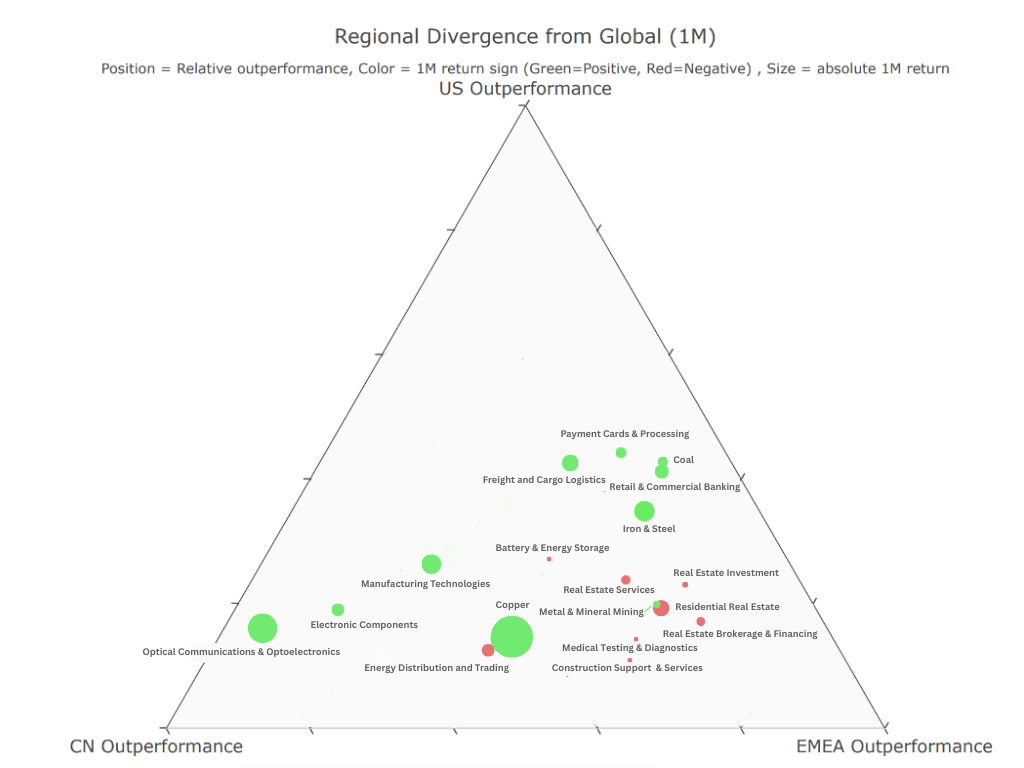
This analysis showcases the top three outperforming and underperforming investment themes across major regions, utilising the Theia Insights Industry Classification (TIIC) framework. By examining how identical themes perform differently across geographical markets, this breakdown illuminates the critical impact of regional economic dynamics, regulatory landscapes, and geopolitical developments on thematic investment returns.
Regional Performance Divergence vs Global
Each point's position indicates the relative regional outperformance compared to the global average. The analysis includes tradable portfolios in all three regions, excluding themes that lack sufficient market presence or liquidity.
Global Sector Thematic Performance (Top and Bottom Performing Themes by Sector)
This dashboard examines thematic investment performance organised by the top-level sectors within the Theia Insights Industry Classification (TIIC) framework. For each sector we report the top three and bottom three performing themes. By grouping themes under their primary sector classifications, this analysis reveals how broad sectoral trends influence underlying thematic opportunities and risks.