February 2026 Performance Synopsis
February was a month of stark divergence across thematic portfolios, with precious metals and commodities surging to the top while technology and digital themes suffered significant losses. The spread between the best and worst performers exceeded 35 percentage points, underscoring just how dramatically sentiment shifted away from growth-oriented themes and toward tangible, real-asset plays.
Best Performing Themes
Silver +20.49%
Chinese Speculative Demand and Buying Surge: Chinese traders and investors drove significant silver buying, contributing to meteoric price gains, though also contributing to sharp crashes when positions unwound. Structural Chinese demand remained a key bullish factor. [3, 4, 15]
Geopolitical Tensions and Tariff Threats Driving Safe-Haven Flows: Trump's unpredictable trade policies, fresh tariff threats, and geopolitical uncertainty (including Iran nuclear deal stalling) pushed investors toward precious metals as safe havens, supporting silver's strong monthly return. [1, 8, 13, 20]
Central Bank Buying and Dollar Dynamics: Heavy central bank purchases of precious metals and shifts away from dollar dominance (BRICS nations) provided a structural tailwind. However, Fed-related announcements (Warsh nomination) temporarily strengthened the dollar and caused sharp pullbacks. [1, 2, 6, 16, 20]
Structural Supply Deficits: Analysts cited persistent silver supply deficits as a fundamental driver supporting higher prices, with Citi targeting $150 silver based partly on this factor. [3, 18]
Extreme Volatility with Strong Buy-the-Dip Behaviour: Silver experienced dramatic swings — record highs followed by sharp crashes — but investors consistently bought dips, with ETF inflows doubling and physical demand overwhelming coin shops, ultimately resulting in a strong net monthly gain. [5, 7, 10, 12, 14, 17, 19]
Risk Asset Correlation and Rotation Dynamics: Silver moved in tandem with broader risk-off episodes (tech selloffs, bitcoin plunges) but also benefited from rotation out of equities and crypto into precious metals during periods of market stress. [9, 11, 19, 21]
Metal & Mineral Mining +20.26%
US Government Strategic Minerals Initiative (Project Vault): Trump's $12 billion rare earth minerals stockpile and the Critical Minerals Ministerial with 50+ countries created enormous bullish sentiment for mining stocks, with companies like USA Rare Earth (+17.4%) and Energy Fuels (+16.7%) surging on the news. This signalled massive government demand and support for the sector. [24, 25, 26, 33, 35, 36, 39, 40, 42]
Global Diversification Away from China: Multiple international deals — India-Brazil mining pact, Japan's seabed rare earth retrieval, India's Rare Earth Corridor — reflected an accelerating global push to reduce dependence on Chinese minerals, boosting demand expectations for non-Chinese mining operations. [22, 23, 38, 41, 48]
Strong Gold Prices and Positive Analyst Sentiment: Gold mining stocks benefited from rising gold prices, with bullish analyst calls on Newmont, Agnico Eagle, and Galiano Gold, plus Morgan Stanley upgrading Harmony Gold. China's $192B gold deposit discovery also highlighted the metal's strategic value. [29, 30, 31, 34, 44, 49]
Supply Tightening from Export Bans and Geopolitics: Zimbabwe's ban on raw mineral and lithium concentrate exports, combined with broader geopolitical tensions around mineral access (Greenland, seabed mining), created supply constraint expectations that supported higher commodity prices. [37, 46, 47]
Major Mining Company Expansion and Investment: Freeport-McMoRan extending Indonesian operations, DOE supporting Lithium Americas, Australian iron ore output ramp-ups, and Bougainville mine reopening all pointed to sector growth and capital deployment. [27, 28, 32, 43, 45]
Gold +17.82%
Geopolitical Tensions and Military Escalation: US-Israel strikes on Iran, unresolved US-Iran nuclear deal, and broader Middle East instability drove strong safe-haven demand for gold throughout February, pushing prices above $5,100. [1, 58, 59, 61, 20]
Weaker Dollar and Fed Rate Cut Expectations: Softer-than-expected US inflation data boosted expectations for Fed rate cuts, weakening the dollar and providing a tailwind for gold prices. Gold reclaimed $5,100 after cooling CPI data. [52, 53, 64, 67]
Trade War Fears and Tariff Escalation: Trump's escalating tariff announcements created economic uncertainty, driving investors toward gold as a safe haven. Gold opened above $5,100 following tariff rulings. [56, 8, 61, 65, 66]
Central Bank Buying and Institutional Demand: Record Russian gold reserves, heavy central bank purchases globally, and massive ETF inflows (doubling in January) provided strong structural demand support. [1, 60, 12, 63]
Distrust in Economic Systems and Dollar Decline: Growing concerns about US debt, dollar weakness, and broader economic instability fueled a structural shift toward gold as an alternative store of value. [50, 51, 54, 62]
Significant Intra-Month Volatility: Despite the strong monthly return, gold experienced sharp selloffs (including a plunge tied to Trump's Fed chair announcement of Kevin Warsh) followed by rapid recoveries, reflecting speculative intensity and shifting sentiment. [6, 17, 55, 8, 57]
Optical Communications & Optoelectronics +17.10%
Nvidia's Silicon Photonics Push and 1.6T Optical Module Development: Nvidia's acceleration of silicon photonics for 800G/1.6T AI data centre interconnects, partnerships with Tower Semiconductor, and expected GTC 2026 spotlight on photonics created enormous investor enthusiasm for the entire optical communications supply chain. [70, 72, 73, 74, 78, 87]
Strong Earnings and Financial Results from Key Optical/Photonics Companies: Tower Semiconductor beat profit estimates on AI-driven demand, GlobalFoundries surged 16% on strong results and accelerated silicon photonics targets, Corning hit all-time highs on stellar earnings, and Applied Optoelectronics reached a 9-year high — collectively validating the sector's growth trajectory. [71, 76, 79, 82, 86]
AI Data Centre Buildout Driving Unprecedented Demand for Optical Interconnects: Hyperscalers' massive CapEx expansion for AI infrastructure created surging demand for fibre optics, silicon photonics, and co-packaged optics, with companies like MediaTek, GlobalFoundries, and Win Semiconductor all positioning aggressively in this space. [68, 69, 75, 77, 81, 85, 88]
Breakthrough Product Announcements and Partnerships in Co-Packaged Optics: Tower Semiconductor and Scintil Photonics announced the world's first heterogeneously integrated DWDM lasers for AI CPO, while multiple partnerships (Salience Labs, Ayar Labs) signalled the technology is moving from R&D to production readiness. [84, 89, 90]
Broadening Fibre Optic Infrastructure Investment: Record fibre deployment to homes, new subsea cable projects, and long-term market projections ($76.46B by 2035) reinforced the secular growth story for optical communications infrastructure. [69, 80, 83]
Catalytic Materials +14.47%
Strong Market Growth Projections for Precious Metal Catalysts: The precious metal catalysts market is projected to exceed $119B by 2032, driven by emission regulations and hydrogen fuel cell adoption, providing a strong macro tailwind for the entire catalytic materials sector. [101]
Breakthrough Innovations in Earth-Abundant Metal Catalysts: Multiple advances in iron, aluminum, and nickel-based catalysts reducing dependence on expensive rare metals signal expanding addressable markets and cost reduction opportunities for catalytic materials companies. [93, 96, 104, 106]
Accelerating Demand from Energy Transition and CO2 Conversion Applications: Numerous advances in catalysts for CO2 reduction, hydrogen evolution, water splitting, and methane conversion reflect growing investment and R&D momentum in clean energy catalysis, expanding the commercial pipeline for catalytic materials. [91, 95, 97, 99, 100, 102]
Advances in Single-Atom and Dual-Atom Catalyst Design: Significant research progress in atomically precise catalytic materials (single-atom, diatomic, and nanocrystal catalysts) demonstrates the sector's technological momentum and potential for higher-performance, higher-value products. [92, 94, 98, 99, 100, 103]
Broadening Industrial Applications: Catalytic materials are finding expanded use cases across pharmaceuticals, biofuels, direct air capture, and fine chemicals, diversifying revenue streams and growth potential for the sector. [102, 104, 105, 106]
Worst Performing Themes
Human Resources -15.09%
AI Disruption Threatening HR/Staffing Business Models: Anthropic's AI plug-ins caused staffing-intensive IT stocks to dive 6%, while IBM recast roles for AI, and McKinsey deployed 25,000 AI agents — all signalling that AI is actively displacing traditional human resources and staffing functions, pressuring sector valuations. [109, 114, 118, 120, 121]
Widespread Layoffs and Workforce Reductions Reducing Staffing Demand: Major institutions including the Washington Post, Kennedy Center, Workday, IRS, and DHS all announced significant staffing cuts, reducing the addressable market for HR services and staffing firms. [107, 108, 110, 112, 113, 123, 124]
Frozen Job Market Depressing HR/Recruitment Revenue: The job market was described as being in a "deep freeze," and while January payrolls beat expectations, overall hiring momentum remained weak, directly reducing demand for staffing agencies and HR service providers. [117, 122]
Offshoring and Immigration Shifts Disrupting Domestic Staffing: Tech giants ramping up India hiring due to immigration restrictions, combined with exposure of H1B underpayment practices at major IT staffing firms, created regulatory and reputational headwinds for the staffing industry. [111, 119]
HR Technology Sector Under Pressure: Workday's 400-job cut amid a broader software stock meltdown reflected investor concerns about AI's impact on HR tech valuations, while companies rethinking performance reviews signalled disruption to traditional HR software workflows. [113, 115, 116]
Accounting & Auditing -12.40%
AI Disruption Fears Intensified: Multiple high-profile statements (Microsoft AI chief predicting full automation of desk work in 18 months, viral essays on AI disrupting finance) created severe negative sentiment around the long-term viability of traditional accounting and auditing roles. [128, 129, 130]
Big Four Margin Compression and Structural Change: KPMG leveraging AI to negotiate lower audit fees, PwC building AI agents for spreadsheet work, and PwC reducing entry-level locations all point to deflationary pricing pressure and workforce contraction across the industry. [126, 131, 132, 133]
AI-Native Competitors Gaining Traction: Significant venture funding for AI-native audit and financial reporting platforms (Fieldguide at $700M valuation, InScope raising $14.5M) signals that disruptive competitors are being well-capitalised to challenge incumbent firms. [137, 138]
Audit Quality and Reputational Concerns: EY raising a red flag on Meta's data-centre accounting and ongoing accounting fraud discourse kept negative attention on audit reliability and the reputational risks facing major firms. [125, 135, 136]
Talent and Cultural Challenges: Former Big Four employees publicly criticising corporate culture and leaving the profession, combined with workforce restructuring, reflect deepening talent retention issues that weigh on sector outlook. [127, 132, 134]
Staffing Services -12.35%
Sector-Wide Valuation Pressure in HR/Payroll Services: Paychex underperformed with cautious Wall Street outlook, reflecting broader investor scepticism toward staffing and HR services companies amid uncertain economic conditions. ADP's relatively stronger positioning may have drawn capital away from smaller staffing peers. [141, 142]
Strong Labour Market Paradoxically Hurting Staffing Stocks: The 130K jobs added in January exceeded expectations, which while positive for employment, dashed hopes for interest rate cuts. Higher-for-longer rates pressure staffing firms' valuations and increase borrowing costs, while a tight labour market can compress staffing margins. [149, 152]
Government Workforce Reductions and Policy Uncertainty: DOGE-driven federal layoffs and USAID dismantlement created uncertainty in government-adjacent staffing demand, while broader tariff and policy concerns weighed on business confidence and hiring plans. [139, 152]
Competitive and Margin Pressures from Technology Disruption: AI-driven workforce management tools and growing applicant volumes (9x increase per Joveo) threaten traditional staffing business models by enabling companies to manage recruitment internally, reducing reliance on staffing intermediaries. [140, 143, 145, 151]
Mixed Signals from Industry M&A and Earnings: While M&A activity (Synergie/Flexwork, Atlantic International/Circle 8) suggests consolidation, Brunel's results described only "stabilising performance," and YY Group's ATM offering signals potential dilution — collectively painting a picture of a sector navigating headwinds. [144, 146, 147, 148, 150]
Private Equity -11.83%
AI Doomsday Fears Triggered PE Stock Selloff: A viral 7,000-word report from Citrini Research painted a dark picture of AI's impact on knowledge work, causing Blackstone and other PE-linked stocks to drop over 7%, contributing significantly to the sector's -11.83% return. [158, 162, 163, 157]
Worst Distribution Crisis Since 2008: Bain & Co reported PE distributions relative to NAV fell to just 14%, worse than during the Global Financial Crisis, reflecting severe liquidity constraints and inability to return capital to LPs. [159, 161, 155]
Broader Market Risk-Off Environment Hitting PE-Exposed Equities: Private equity stocks were caught in a broader selloff alongside software and high-multiple names, with crypto correlation amplifying downside as investors fled risk assets. [158, 162, 163]
Negative Operational Narratives Around PE-Owned Companies: High-profile examples including Walgreens layoffs post-buyout, Joann Fabrics' LBO-driven bankruptcy, and cybersecurity failures at PE-owned Ivanti reinforced concerns about PE's debt-heavy, cost-cutting model damaging portfolio companies. [153, 156, 160]
Dealmaking Recovery Stalled Despite Backlog: While Goldman's CEO cited a PE spending backlog and the secondaries market surged to $240B, actual deal completion and exits remained constrained, keeping returns depressed. [154, 155, 161]
Artificial Intelligence -11.80%
Investor Disillusionment with AI Hype: The underwhelming release of ChatGPT-5 appears to have been a turning point where investors began reassessing whether AI would deliver on its transformative promises, with commentary about "AI psychosis" on Wall Street and experts calling out that investors were "sold a bill of goods." [173, 174, 164]
Anthropic-Pentagon Standoff Over Military AI Use: A major escalation between Anthropic and the U.S. Department of Defense over AI safety guardrails threatened hundreds of millions in government contracts. The Trump administration's decision to ban Claude from federal use after Anthropic refused to remove surveillance restrictions created significant uncertainty about government AI spending and political risk across the sector. [165, 170, 171, 172, 177, 179]
Chinese AI Competition and IP Theft Concerns: DeepSeek's alleged distillation of US AI models (both OpenAI and Anthropic) raised serious concerns about the defensibility of US AI companies' competitive advantages, undermining the premium valuations investors had assigned to these firms. [168, 178]
Rising Infrastructure Costs and Monetisation Pressure: Growing awareness of AI's massive energy demands (42% electricity cost increases) and OpenAI's move to introduce ads in ChatGPT suggested that the path to profitability for AI companies is more challenging and costly than previously assumed. [166, 167, 176]
Product Execution Concerns: OpenAI's retirement of the popular GPT-4o model amid user backlash and delays to hardware products (Jony Ive device pushed to 2027) raised questions about execution quality at leading AI companies. [175, 169]
Cross-Month Comparison
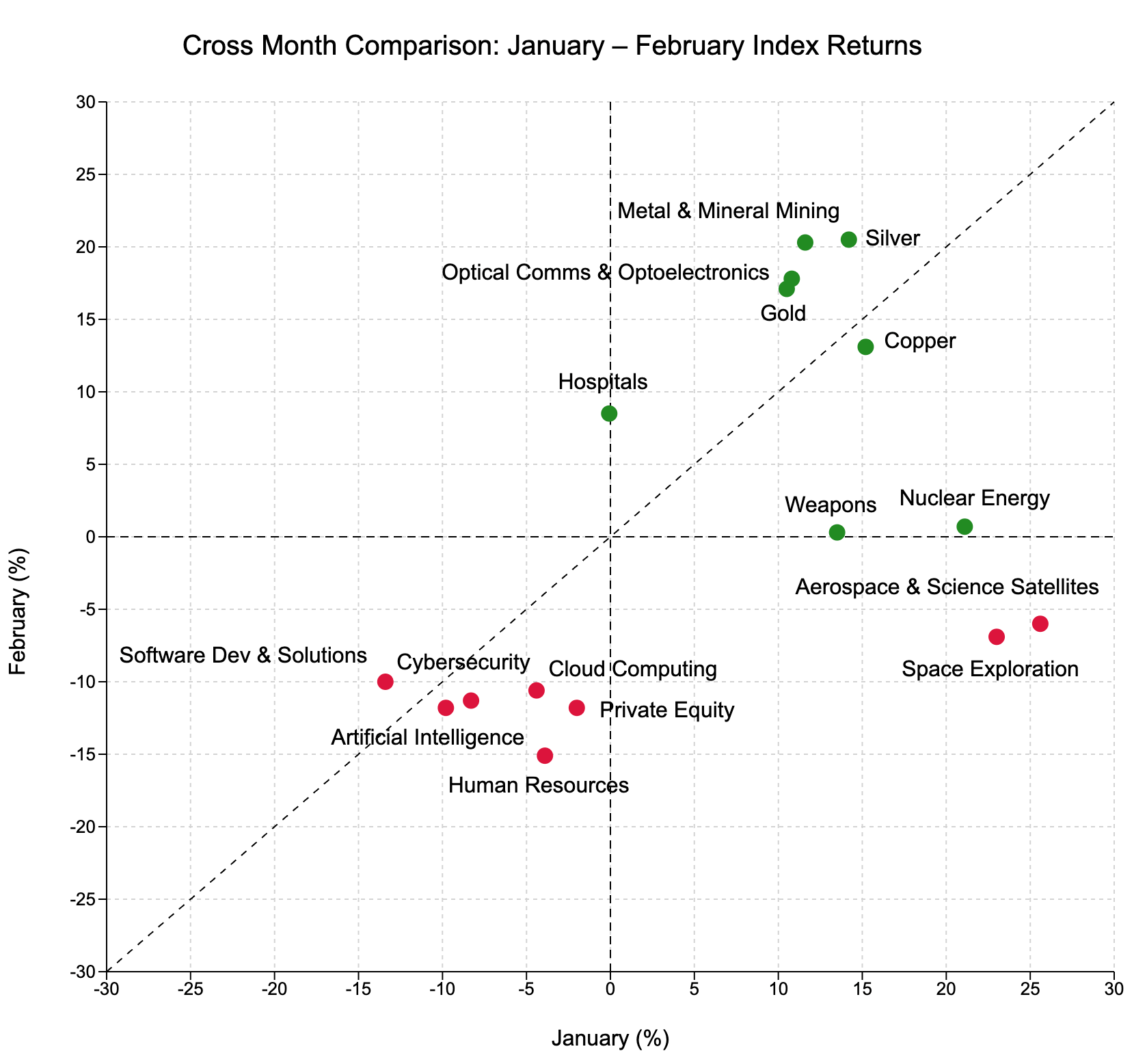
In February, leadership rotated decisively into precious metals and mining, with Silver, Gold, and Copper extending powerful momentum. Meanwhile, January's space and nuclear winners reversed or stalled, highlighting a swift unwind of momentum trades.
Technology remained broadly weak across both months — AI, Software, Cloud, Cybersecurity, and Private Equity all posted continued losses — though Optical Communications stood out as a rare hardware-linked outperformer.
Overall, the period reflected sharp sector rotation: capital moved into metals and defensives while high-growth tech faced sustained selling pressure.
Interesting Themes from Cross-Month Comparison
Aerospace & Science Satellites Jan +25.61% → Feb -6.04%
Persistent Artemis Program Delays and Restructuring: Multiple reports throughout February revealed NASA pushing back Artemis II (delays from March to April), returning the moon rocket to the hangar for repairs, and fundamentally revamping the Artemis program by adding an interim mission before any lunar landing. This eroded confidence in NASA's human spaceflight timeline and negatively impacted sentiment for aerospace contractors dependent on these programs. [181, 183, 188, 189, 193, 195, 196]
Boeing Starliner Fallout and NASA Management Criticism: NASA's new administrator publicly excoriated Boeing and agency managers for the botched Starliner mission, generating sustained negative press. This damaged confidence in commercial crew programs and raised questions about contractor reliability across the aerospace sector. [184, 185, 187]
Regulatory and Competitive Uncertainty Around Mega-Constellations: SpaceX's announcement of plans for one million datacenter satellites drew FCC scrutiny and public scepticism, while the FCC simultaneously granted competitor Logos clearance for 4,178 satellites. This combination of regulatory risk and intensifying competition created uncertainty about the economics and feasibility of LEO satellite business models. [182, 192, 194]
Profit-Taking After Strong January Rally: After a 25.61% gain in January, the -6.04% February decline likely reflects natural profit-taking and mean reversion, especially as the positive catalysts from January gave way to a news cycle dominated by delays, program restructuring, and competitive threats rather than new growth catalysts. [181, 189, 192, 194]
Geopolitical Tensions and Space Security Concerns: Russian satellite interception of European communications and satellite imagery of US/Israeli strikes on Iran highlighted growing militarisation and vulnerability of space assets, introducing risk premiums into the sector. [180, 191]
Strategic Uncertainty from SpaceX/xAI Merger and Lunar Pivot: Musk's decision to fuse SpaceX with xAI and pivot toward a moon city over Mars introduced strategic ambiguity about resource allocation and focus, potentially unsettling investors in the broader SpaceX ecosystem. [186, 190]
Space Exploration Jan +23.00% → Feb -6.86%
NASA Artemis Program Delays and Restructuring: NASA significantly pushed back its Moon landing plans from Artemis III to Artemis IV (2028), and Artemis II faced repeated delays with potential slippage from March to April. This represents a major deceleration in human space exploration ambitions, dampening investor enthusiasm for the sector. [188, 197, 193, 205, 181, 196]
SpaceX-xAI Mega-Merger Creating Strategic Uncertainty: The $1.25 trillion all-stock merger of SpaceX and xAI raised concerns that SpaceX's focus and resources would shift from space exploration toward AI data centres in orbit. Co-founder departures and organisational instability post-merger further unsettled investors about the direction of the most important private space company. [198, 200, 202, 186, 204, 206, 207, 208]
Boeing Starliner Fallout and Industry Safety Concerns: NASA officially classified the Starliner failure as a maximum-level Type A mishap, and NASA's new administrator publicly excoriated Boeing and agency leadership. Combined with the ISS medical evacuation disclosure, this painted a picture of safety and reliability challenges across the industry. [185, 199, 187, 184, 209]
Shift from Pure Exploration to Commercial/AI Applications: Musk's pivot from Mars colonisation to lunar cities, combined with plans for million-satellite orbital AI data centres, signalled that the space industry's narrative was shifting away from exploration toward commercial AI infrastructure, potentially disappointing investors focused on traditional space exploration themes. [201, 190, 203, 192, 182]
Profit-Taking After Strong January: The 23% gain in January likely set up conditions for a correction, and the accumulation of negative catalysts (program delays, merger uncertainty, safety concerns) provided reasons for investors to take profits. [188, 198, 205, 209]
Nuclear Energy Jan +21.14% → Feb +0.74%
Deceleration After Massive January Rally (Profit-Taking): After a 21.14% surge in January, the sharp slowdown to 0.74% in February suggests significant profit-taking and mean reversion, as investors locked in gains from the prior month's momentum. [210, 215]
Continued but Moderating Policy Tailwinds from Trump Administration: The Trump admin continued pushing nuclear through streamlined environmental reviews, microreactor military demonstrations, and international nuclear deals (Armenia, Hungary), but these were incremental rather than transformative announcements, providing support but not fresh catalysts for further upside. [212, 217, 220, 223, 224, 225, 227]
SMR Economic Viability Concerns Tempering Enthusiasm: Reports questioning whether SMRs would ever be economically viable introduced scepticism into the narrative, counterbalancing bullish theses and slowing momentum. [215, 210]
Positive Milestones Offset by Operational Setbacks: While NOVA Core's criticality achievement and X-Energy's NRC fuel licence were positive, the shutdown of the Northwest's only nuclear plant and Zaporizhzhia safety concerns introduced negative headlines. [221, 211, 216, 222]
AI-Nuclear Demand Narrative Sustained but Priced In: The ongoing narrative of AI hyperscalers securing uranium supply and nuclear power for data centres continued, but after January's massive run-up, this theme was largely already reflected in valuations. [228, 226, 211]
Iran Nuclear Tensions Creating Geopolitical Uncertainty: Extensive US-Iran nuclear negotiations and military posturing created background geopolitical noise that may have introduced caution among nuclear energy investors regarding broader market risk. [213, 214, 219]
Software Development & Solutions Jan -13.39% → Feb -9.95%
AI Existential Threat Narrative Intensified for SaaS/Software Business Models: Throughout February, a crescendo of commentary from prominent investors (Bill Gurley), consultants (AlixPartners), and industry insiders argued that AI agents threaten the per-seat SaaS licensing model and could replace traditional business software entirely, creating severe negative sentiment. [229, 230, 238, 241, 245, 246]
High-Profile Software Stock Sell-Off and Wealth Destruction: Oracle's stock plunge (Larry Ellison losing $49B) exemplified a broad-based software sector sell-off, with SaaS stocks experiencing a "meltdown" as investors repriced the sector amid AI disruption fears. [236, 240]
AI Productivity Gains Accelerating Workforce Reductions in Software Companies: Major companies like Block (40% layoffs) and statements from Anthropic and Microsoft AI leadership about AI automating white-collar tasks and reducing the value of junior engineering roles signalled that software companies themselves are shrinking headcounts, raising questions about future revenue growth across the sector. [234, 242, 243, 231]
AI Coding Agents Reaching Critical Adoption Thresholds: Claude Code authoring ~4% of GitHub commits, OpenAI launching Codex, and the "death of the SDLC" narrative suggested AI is not just augmenting but replacing traditional software development workflows, threatening developer tools and platform companies. [232, 237, 239, 244]
Capital Reallocation from Traditional Software to AI Infrastructure: Massive capex increases by hyperscalers (Amazon, Microsoft, Google) directed toward AI infrastructure rather than traditional software spending, combined with fundraising for AI-native startups, suggested investor capital is flowing away from incumbent software companies. [233, 235]
Copper Jan +15.16% → Feb +13.08%
Persistent Supply-Demand Imbalance: Copper continued to benefit from structural undersupply relative to growing demand, particularly from electrification, AI data centres, and clean energy infrastructure, sustaining bullish momentum from January into February. [248, 258, 260]
Chinese Demand Dynamics: China remained the dominant demand driver, with dip-buying emerging during price pullbacks and Chinese output driving Congo's 10% export increase, though speculative Chinese trading also contributed to volatility. [247, 262, 4]
Price Volatility and Profit-Taking in Late February: After strong gains, copper experienced notable pullbacks with LME prices dropping as much as 5.7% intraday, rising global stockpiles, and bearish futures signals, suggesting some moderation of the rally pace compared to January's 15.16% gain. [247, 259, 251, 252, 263]
Strong Corporate Earnings Validating Copper Bull Case: Major miners like BHP and Southern Copper reported strong results driven by elevated copper prices, while new production (Taseko's Florence Copper) came online, reinforcing investor confidence. [255, 253, 261, 249]
US Strategic Stockpiling and Investor Flows: The US accumulated 590,000 tons of copper in warehouses, and institutional investors including family offices increasingly allocated to copper, adding demand-side pressure and financial flows supporting prices. [260, 254, 257]
Supply-Side Disruptions and Governance Risks: Codelco's executive firings at El Teniente and regulatory challenges at Vedanta's Indian operations highlighted ongoing supply-side risks that supported prices. [250, 256]
Region Best and Worst Performing Themes
Cables & Wires APAC-ex-CN +21.15%
Massive Global Fibre-Optic and Data Centre Buildout: Record US fibre deployment, billions in federal broadband grants, and surging data centre construction created enormous demand for cables and wires, benefiting APAC-ex-CN manufacturers as key suppliers in the global supply chain. [69, 86, 268, 269, 274]
Submarine Cable Infrastructure Investment Surge: International agreements among 70+ countries to strengthen submarine cable resilience, combined with tech giants' expanding undersea cable ownership, drove increased orders and positive sentiment for cable manufacturers across APAC. [265, 267, 272, 273]
AI-Driven Infrastructure Demand: The AI boom requiring massive data centre power and connectivity infrastructure created sustained demand for power cables, fibre-optic cables, and specialty wiring, with APAC manufacturers well-positioned to supply this growth. [264, 266, 271, 274]
Strong Earnings from Cable Sector Bellwethers: Corning's all-time high stock price on stellar earnings and a new billion-dollar deal provided a strong positive signal for the entire cables and wires value chain, lifting sentiment across the sector globally. [86, 268]
Telecom Infrastructure Expansion in APAC: Continued digital connectivity investments across APAC markets, including fibre deployments and telecom network upgrades, directly supported revenue growth for regional cables and wires companies. [264, 270, 273]
Engines & Powertrains CN +14.26%
Regulatory Tailwinds from Trump EPA Emissions Rollback: The repeal of federal emissions limits reduced pressure on automakers to abandon ICE powertrains, boosting sentiment for traditional engine and powertrain manufacturers and extending the commercial runway for combustion-based products. [276]
Horse Powertrain (Geely-Renault JV) Breakthrough Hybrid Technology: Multiple announcements around Horse Powertrain's H12 Concept engine (44.2% thermal efficiency) and 70+ mpg hybrid concept demonstrated China-linked powertrain innovation leadership, directly boosting CN-listed engines & powertrains stocks. [277, 279, 284]
Continued OEM Investment in Advanced ICE and Hybrid Powertrains: Major automakers (Audi, Mercedes-AMG, Mazda) announced new inline-six engines, PHEV performance models, and advanced ICE designs, signalling sustained demand for sophisticated combustion and hybrid powertrain components rather than an abrupt EV-only transition. [275, 278, 280, 282, 283]
Positive Sentiment Toward Powertrain Component Suppliers: Hedge fund bullishness on companies like Garrett Motion and broader enthusiasm for turbocharger and powertrain technology reflected investor confidence in the sector's growth prospects amid hybrid adoption. [285]
F1 Powertrain Competition Driving Technology Perception: The 2026 F1 season's new engine regulations and competitive shakedowns (Mercedes leading Ferrari) generated positive visibility for advanced powertrain engineering capabilities. [281, 286]
Manufacturing & Precision Tools CN +13.93%
Chinese 3D Printing / Additive Manufacturing Breakthroughs: Tsinghua University's sub-second volumetric 3D printing technology (DISH) represented a major precision manufacturing innovation originating from China, generating significant positive sentiment for CN manufacturing and precision tools companies. [287, 291, 293]
Growing Industrial Automation and Smart Manufacturing Momentum: Major companies like Siemens signalling aggressive automation strategies, combined with AI-powered manufacturing quality control systems, reinforced confidence in the precision tools and manufacturing equipment sector. [288, 292, 295]
Expanding Applications for Additive Manufacturing: Adoption of 3D printing across aerospace (NASA, US Navy), construction, and soft robotics validated growing demand for precision manufacturing tools and equipment, supporting sector growth expectations. [289, 296, 294, 300, 297]
Global Manufacturing Supply Chain Realignment: Apple's expanded manufacturing in India and the US, including robotics and automation training programs, signalled increased capital expenditure on precision manufacturing equipment globally, benefiting the sector. [290, 299]
Nano-Scale Precision Manufacturing Advances: Research in nano-architected metals and advanced lithography techniques pushed the frontier of precision manufacturing, supporting long-term growth narratives for the sector. [298]
Weight Loss & Diabetes EMEA -21.59%
Novo Nordisk's Shocking 2026 Revenue Guidance: The company warned of a 5-13% decline in global sales for 2026, driven by lower drug prices in the US (including deals with the Trump administration) and intensifying competition, causing shares to plunge 11-16% in Copenhagen and dragging the entire EMEA Weight Loss & Diabetes theme down. [303, 304, 307, 317, 320]
CagriSema Clinical Trial Disappointment: Novo Nordisk's next-generation obesity drug CagriSema proved less effective than Eli Lilly's tirzepatide (Mounjaro) in head-to-head comparisons, severely denting Novo's obesity pipeline comeback narrative and triggering a major sell-off. [308, 309, 315]
Eli Lilly's Competitive Dominance Intensifying: Lilly's orforglipron outperformed oral semaglutide in head-to-head trials, the company posted 45% sales growth, and guided for $80-83bn in 2026 revenue, widening the competitive gap with Novo Nordisk and pressuring EMEA-listed weight loss/diabetes stocks. [301, 302, 306, 316]
Pricing Pressure and Margin Compression: Novo Nordisk announced plans to slash Wegovy/Ozempic prices by up to 50%, compounded alternatives emerged at dramatically lower price points ($49/month), and political pressure from the Trump administration forced price concessions — all signalling structural margin erosion. [311, 312, 313, 314, 319]
Safety and Regulatory Concerns in EMEA: The EMA confirmed doubled blindness risk with GLP-1 drugs, UK regulators issued pancreatitis/death warnings, and Danish patients received compensation for eye disease — adding regulatory headwinds specifically in the EMEA region. [305, 310, 318]
Special Purpose Acquisition EMEA -13.07%
Negative Sentiment and Poor SPAC Deal Performance Undermining Confidence: Several SPAC-linked entities experienced severe value destruction — notably the Khaby Lame SPAC partner losing 90%+ of value, and DJT shares slipping on spin-off news. Public sentiment articles mocking SPAC investments as "dumb" reflect continued reputational damage to the asset class. [322, 327, 333]
New SPAC IPOs Flooding the Market Without Corresponding Demand: Multiple new SPAC IPOs launched in February (Cambridge $230M, Hennessy $241.5M, Muzero $201M, Iris $150M, Proem $130M), potentially diluting investor interest and creating supply-demand imbalance that pressures existing SPAC valuations in EMEA and globally. [328, 330, 332, 334, 338, 339, 344]
EMEA-Based Companies Using SPACs to List in the US, Draining EMEA SPAC Value: Major EMEA companies like IQM (Finland), ThomasLloyd, Einride, and General Fusion chose US-listed SPACs for their public market debuts, suggesting capital and value migration away from EMEA markets, contributing to the -13.07% EMEA SPAC return. [321, 323, 324, 325, 331, 341, 342, 345]
Extended Timelines and Struggling Deal Completions Signalling SPAC Distress: SPACs like Inception Growth needing trust extensions, and multiple entities still filing amended registration statements and scheduling shareholder votes, indicate prolonged uncertainty and redemption pressure that erodes SPAC share prices. [326, 335, 336, 337, 340]
Broader Market Volatility and Risk-Off Sentiment Impacting Speculative Vehicles: References to AI stock shorting concerns, crypto treasury company declines, and general market turbulence created an unfavourable environment for speculative investment vehicles like SPACs, particularly in EMEA where the asset class has less liquidity. [329, 343]
3D Technology & Design EMEA -12.70%
Regulatory Headwinds Across Multiple Jurisdictions: New York passed restrictive 3D printing legislation, California sued over 3D-printed firearm file distribution, and US-level efforts to limit sharing of 3D printing files all contributed to negative sentiment around the 3D printing and design sector, raising concerns about growth constraints and compliance costs. [218, 348, 352]
Legal Uncertainty for Major Players: Autodesk's trademark lawsuit against Google over the "Flow" name introduced legal risk and distraction for one of the sector's largest companies, potentially weighing on investor confidence in the EMEA-listed 3D technology and design theme. [346]
Major Tech Platform Retreat from 3D Tools: Microsoft's deprecation of its 3D Viewer app signalled waning commitment from large platform companies to 3D design tools, reinforcing concerns about mainstream adoption stalling and reducing perceived growth potential. [349]
Industry Consolidation Reflecting Monetisation Struggles: MyMiniFactory's acquisition of Thingiverse, while framed positively as protecting creators from AI scraping, also highlighted the financial fragility of 3D printing platforms and ongoing challenges in monetising user-generated 3D content. [347, 350, 351]
Broader Market Rotation Away from Niche Tech Themes: The -12.70% decline in EMEA likely also reflects broader risk-off sentiment in February affecting smaller, more speculative technology themes, with 3D technology and design lacking near-term catalysts to offset regulatory and competitive headwinds. [218, 348, 349, 352]
Commodities Equity Performance Dashboard
This dashboard provides performance analytics for global equities with exposure to commodities-related themes in Theia Insights Industry Classification (TIIC), grouped by Industry (level two).
Regional Thematic Performance Overview (Top and Bottom Performing Themes by Region)
This analysis showcases the top three outperforming and underperforming investment themes across major regions, utilising the Theia Insights Industry Classification (TIIC) framework. By examining how identical themes perform differently across geographical markets, this breakdown illuminates the critical impact of regional economic dynamics, regulatory landscapes, and geopolitical developments on thematic investment returns.
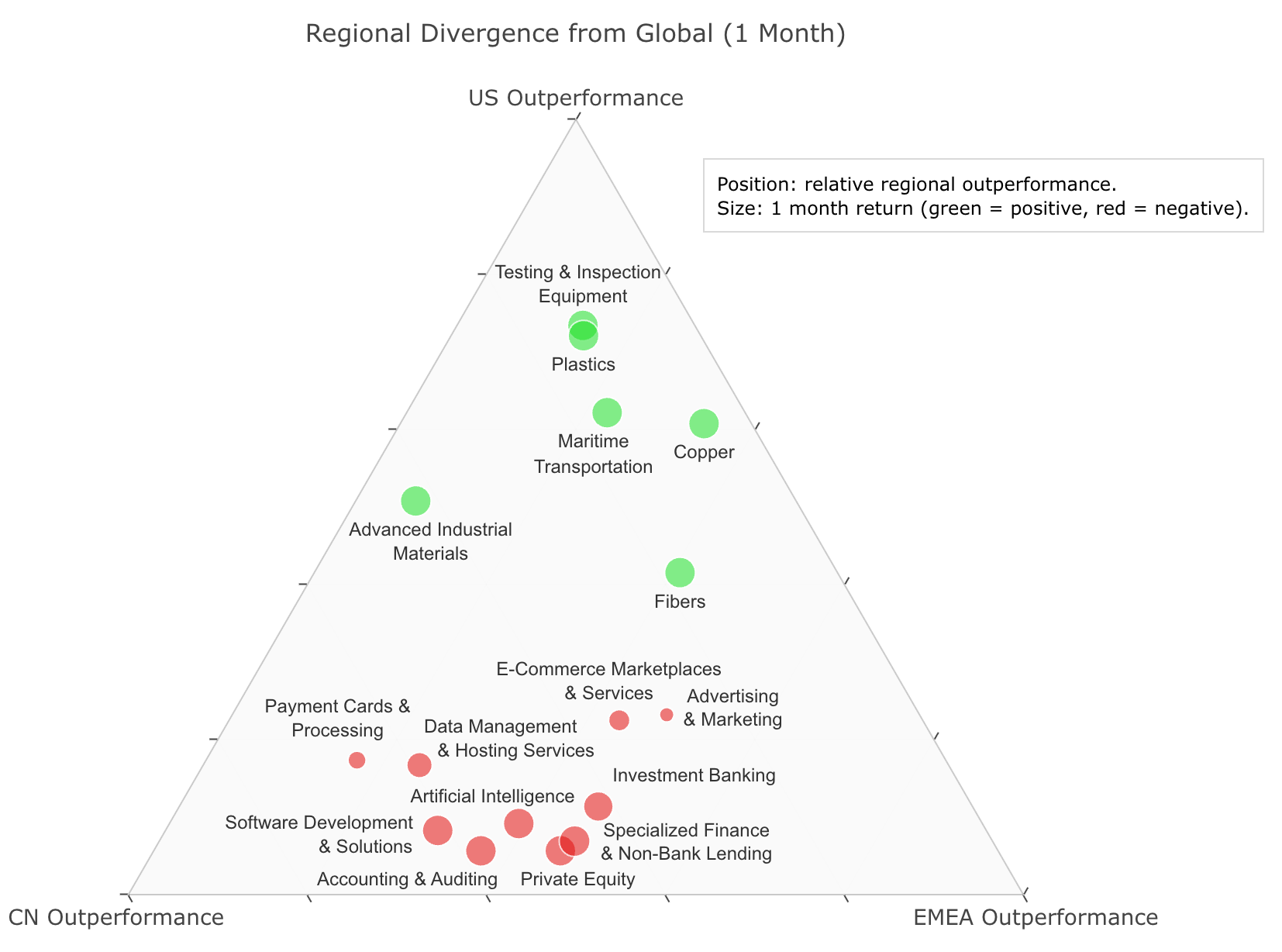
Regional Performance Divergence vs Global
Each point's position indicates the relative regional outperformance compared to the global average. The analysis includes tradable portfolios in all three regions, excluding themes that lack sufficient market presence or liquidity.
Global Sector Thematic Performance (Top and Bottom Performing Themes by Sector)
This dashboard examines thematic investment performance organised by the top-level sectors within the Theia Insights Industry Classification (TIIC) framework. For each sector we report the top three and bottom three performing themes. By grouping themes under their primary sector classifications, this analysis reveals how broad sectoral trends influence underlying thematic opportunities and risks.