March 2026 Performance Synopsis
March performance showed a clear and striking divergence across themes, with energy-related sectors dominating gains while most other areas faced broad-based weakness. Biofuels and Industrial & Specialized Gas led returns, supported by strong performances in Oil & Petroleum and Natural & Liquefied Gas, indicating a powerful rally across the energy complex. This strength extended to adjacent areas like Chemicals and certain industrial and agriculture-linked themes, suggesting supportive commodity dynamics and possibly geopolitical tailwinds. However, the gains were not uniform across all energy segments, as renewable-focused themes like Solar Energy and Wind Energy lagged, highlighting a preference for traditional and transitional energy sources.
Outside of energy, the market environment appeared largely risk-off. Financials and technology sectors posted consistent, moderate losses, reflecting reduced appetite for growth and innovation-driven themes. This negative sentiment intensified in industrial, consumer, and healthcare sectors, where double-digit declines pointed to concerns around economic slowdown and weakening demand. Consumer discretionary and manufacturing-related themes were particularly hard hit, reinforcing the narrative of deteriorating economic expectations.
At the extreme end, metals and mining experienced the steepest losses, with Silver, Copper, Nickel, and Gold all declining sharply. This was notable given the strength in energy, suggesting a disconnect possibly driven by expectations of reduced industrial demand or an unwind of prior speculative positioning. Meanwhile, speculative technology areas like Quantum Technology also suffered significant declines.
Overall, March reflected a market undergoing sharp rotation, favouring energy exposure while broadly de-risking across growth, industrial, and commodity-linked sectors, consistent with a more defensive or stagflationary backdrop.
Best Performing Themes
The top performers were almost entirely an energy story. The Iran war's oil shock made Biofuels economically compelling, removed 30% of global helium supply and devastated industrial gas availability across Asia, pushed Brent briefly to $119-120/barrel in the largest supply disruption in oil market history, and triggered a near-40% surge in European gas prices following the Ras Laffan LNG strike. Optical Communications was the only non-energy theme to post meaningful gains, buoyed by Nvidia's multi-billion-dollar optical infrastructure commitments and strong momentum from OFC 2026.
Worst Performing Themes
Silver reversed sharply from February's top spot as institutional ETF outflows, a stronger dollar, and industrial demand collapse fears drove a 16.5% single-week drop. Quantum Technology's gap between valuations and commercial reality became impossible to ignore, with Rigetti's $7.1M annual revenue and a collective $930M warning from leading quantum stocks triggering broad sector capitulation. Nickel and Copper both fell ~17% as Gulf shipping disruptions threatened Indonesian production inputs while simultaneously raising fears of a global industrial demand slowdown — a doubly bearish combination.
Cross-Month Comparison
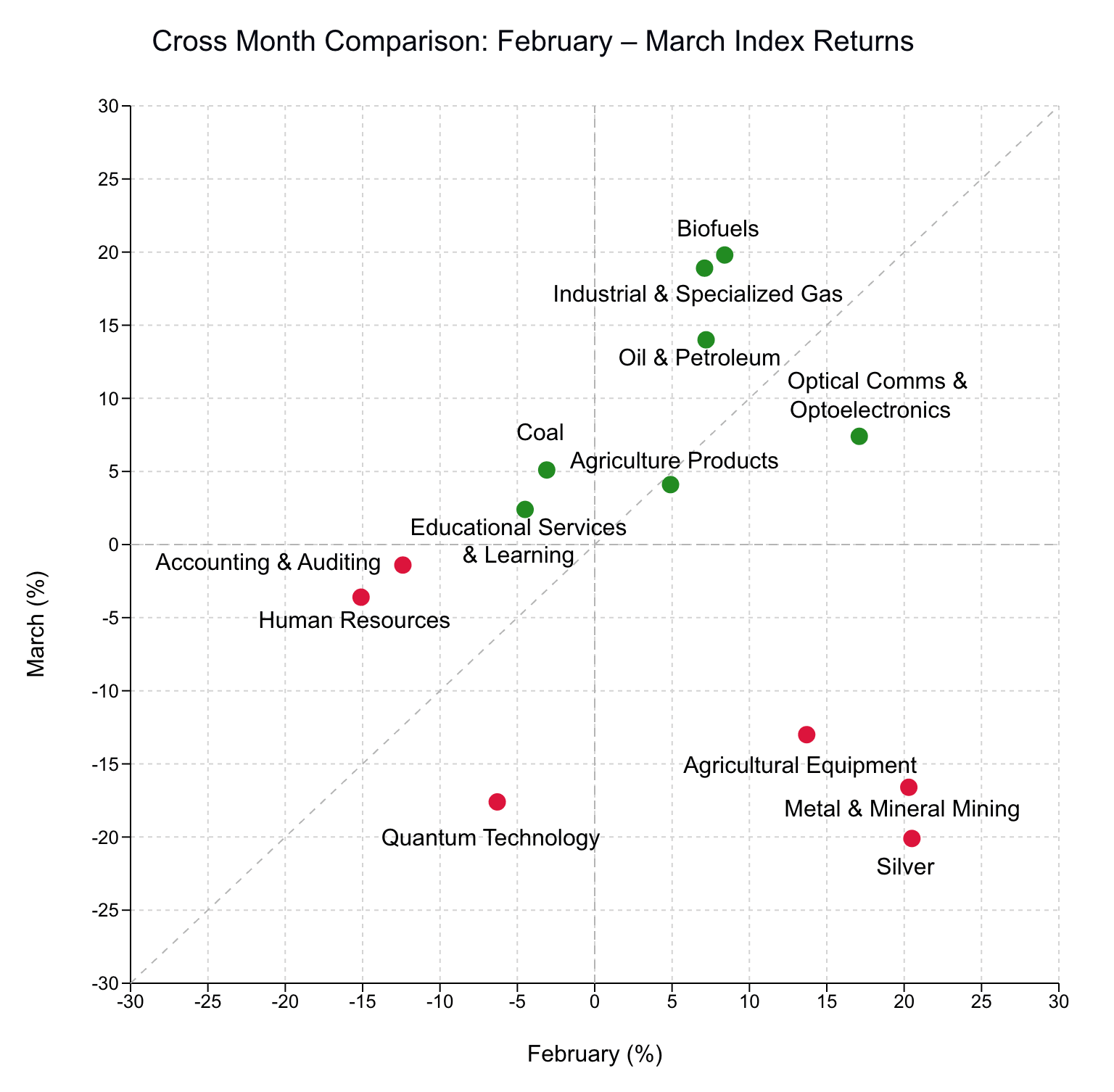
Silver and Metal & Mineral Mining both topped February's leaderboard before crashing in March — classic speculative unwinds. Energy themes told the opposite story, with Biofuels and Industrial & Specialized Gas accelerating from solid February gains into March's top two spots, suggesting a sustained structural bid. Quantum Technology was notable for losses that intensified rather than stabilised month-on-month, pointing to genuine capitulation, while Accounting & Auditing showed the sharpest recovery, pulled from -12.4% to just -1.4% by Tether's landmark Big Four audit engagements.
Interesting Themes from Cross-Month Comparison
March saw sharp reversals across several themes that had been strong in February. Energy-adjacent sectors held up, but metals, equipment, and professional services all gave back gains as the Iran war shifted from a supply shock into a sustained drag on global growth expectations.
Region Best and Worst Performing Themes
Performance diverged across themes. Cables & Wires (APAC ex-China) and Manufacturing & Precision Tools (China) gained on AI-driven infrastructure and automation demand, while Engines & Powertrains (China) benefited from a shift back to hybrid and ICE systems.
On the downside, Weight Loss & Diabetes (EMEA) fell due to pricing pressure and safety concerns, Private Equity (US) declined amid liquidity stress, and SPACs (EMEA) weakened on poor sentiment and governance issues.
Overall, industrial themes outperformed, while financial and healthcare sectors faced headwinds.
Themes on the Radar
PFAS Technology and Management — a regulatory tipping point arrives
PFAS "forever chemicals" hit a dual-jurisdiction regulatory inflection in March 2026 that makes this theme impossible to ignore. On March 3, the European Chemicals Agency's Risk Assessment Committee adopted its final opinion supporting a comprehensive EU-wide restriction on all PFAS under REACH — the broadest chemical regulation ever attempted in Europe. Just eight days later, on March 11, ECHA's Socio-Economic Analysis Committee agreed its draft opinion, launching a 60-day public consultation. Both committees concluded that PFAS risks "are not currently controlled well enough," and RAC recommended restricting manufacture, use, and sale with as few derogations as possible.
Simultaneously in the United States, on March 19 Rep. McCollum and Sen. Durbin reintroduced the "Forever Chemical Regulation and Accountability Act," setting a 10-year national deadline to eliminate PFAS wherever possible. Nearly 100 state-level PFAS bills have been introduced across 17 states in 2026 alone. The convergence of EU restriction and US legislative pressure creates a massive addressable market for PFAS remediation, alternative chemistry, and water treatment technologies. [349, 350]
Alpha Particle Therapies are drawing nine-figure bets
Radiopharmaceuticals crossed a major commercial threshold on March 17, when Bill Gates-backed TerraPower Isotopes announced a $450 million investment in a 250,000-square-foot actinium-225 manufacturing facility in Philadelphia's Bellwether District. The facility — expected operational in 2029 — will increase global Ac-225 production capacity 20-fold when combined with TerraPower's existing Washington site. Pennsylvania committed $10 million in grants, and the project will create 225 permanent jobs. This investment addresses the critical bottleneck limiting alpha particle therapy development: global annual Ac-225 production currently totals less than a grain of sand by weight.
The momentum extends beyond TerraPower. At the Global Radiopharmaceuticals Development Summit in Shanghai on March 19–20, Molecular Partners presented preclinical data showing its Radio-DARPin platform works with both Lead-212 and Actinium-225 alpha isotopes. Actinium Pharmaceuticals released two AACR 2026 abstracts on March 17 covering its Ac-225 radiopharmaceutical therapy programs. Alpha particle therapy is widely viewed as the "next revolution" after lutetium-177, with multiple clinical trials advancing across cancer types. [351, 352]
Virtual Asset Platforms gain landmark regulatory clarity
The crypto industry received its most significant regulatory milestone on March 17, when the SEC and CFTC jointly issued a landmark interpretive release clarifying how federal securities laws apply to digital assets. The guidance establishes a five-part token taxonomy: digital commodities (explicitly including Bitcoin, Ether, Solana, and XRP — declared not securities), digital collectibles, digital tools, stablecoins (under the GENIUS Act framework), and digital securities. SEC Chairman Paul Atkins simultaneously announced a "Regulation Crypto Assets" safe harbor framework at the DC Blockchain Summit, including startup and fundraising exemptions.
This ends over a decade of "regulation by enforcement" and provides the legal certainty that institutional allocators have cited as a prerequisite for broader digital asset adoption. The framework establishes clear jurisdictional boundaries between SEC and CFTC oversight, enabling compliant platform development and institutional product launches. [353]
Commodities Equity Performance Dashboard
This dashboard provides performance analytics for global equities with exposure to commodities-related themes in Theia Insights Industry Classification (TIIC), grouped by Industry (level two).
Regional Thematic Performance Overview (Top and Bottom Performing Themes by Region)
This analysis showcases the top three outperforming and underperforming investment themes across major regions, utilising the Theia Insights Industry Classification (TIIC) framework. By examining how identical themes perform differently across geographical markets, this breakdown illuminates the critical impact of regional economic dynamics, regulatory landscapes, and geopolitical developments on thematic investment returns.
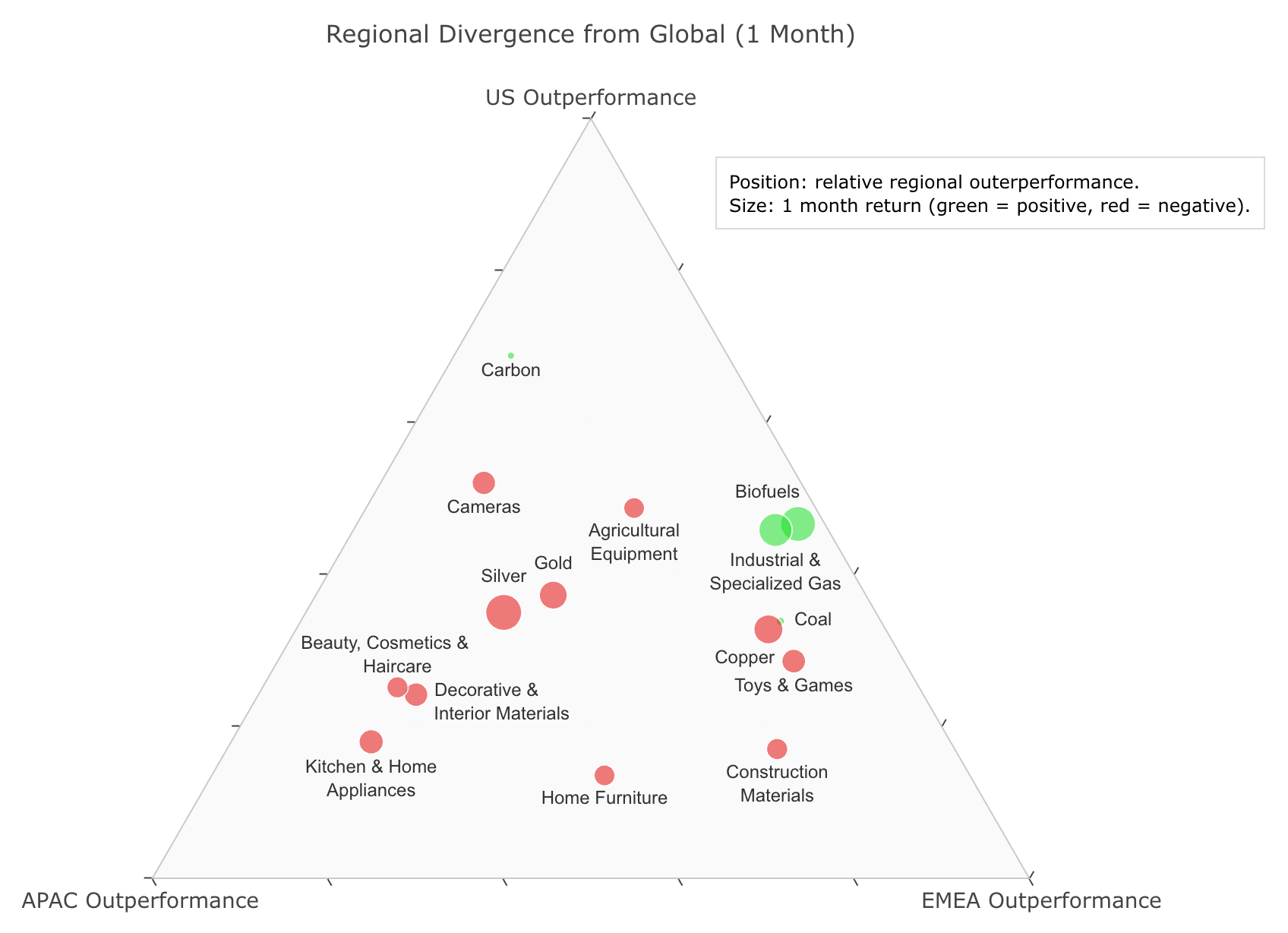
Regional Performance Divergence vs Global
Each point's position indicates the relative regional outperformance compared to the global average. The analysis includes tradable portfolios in all three regions, excluding themes that lack sufficient market presence or liquidity.
Global Sector Thematic Performance (Top and Bottom Performing Themes by Sector)
This dashboard examines thematic investment performance organised by the top-level sectors within the Theia Insights Industry Classification (TIIC) framework. For each sector we report the top three and bottom three performing themes. By grouping themes under their primary sector classifications, this analysis reveals how broad sectoral trends influence underlying thematic opportunities and risks.
Looking Ahead
Markets in the coming months will be heavily influenced by geopolitical and structural shifts. The trajectory of the Iran conflict remains a key determinant for energy prices, with prolonged tension supporting Oil & Petroleum, Natural & Liquefied Gas, and Biofuels, while metals face pressure from slowing industrial demand. Structural challenges persist in Weight Loss & Diabetes, Private Equity, and Quantum Technology, highlighting areas of potential risk. At the same time, emerging opportunities in PFAS Technology, Alpha Particle Therapies, and Virtual Asset Platforms signal transformative growth potential as regulatory and technological milestones unfold. Investors will need to navigate a landscape defined by elevated volatility, sector-specific headwinds, and selective innovation-driven upside.