April 2026 Performance Synopsis
April performance presented a striking contrast to March, with technology hardware and AI infrastructure themes dominating gains while defensive and commodity-linked sectors gave ground. Optical Communications & Optoelectronics, Data Centers & High-Performance Computing, and Radio Frequency Technology led all themes, with Semiconductor Chips and Electronic Components close behind — all posting returns above 30%. This concentration of strength in the physical backbone of AI and cloud computing reflected renewed optimism around capital expenditure cycles and easing supply chain headwinds, representing a near-complete reversal of March's tech weakness.
The rally had meaningful breadth in its middle tier, with Quantum Technology, Sensors, Consumer Electronics, and Manufacturing Technologies all delivering double-digit gains. Digital assets also participated, with Cryptocurrency and Blockchain themes rising sharply, consistent with a broad risk-on tone. Industrial and construction-adjacent themes held up well, suggesting the optimism extended beyond pure tech into the physical economy.
Consumer, financial, and software themes posted modest positive returns but notably lagged the hardware surge. The divergence between software — where AI, Cloud Computing, and Software Development all returned under 10% — and the underlying infrastructure themes was particularly striking, pointing to a clear investor preference for tangible capital expenditure plays over services and platforms.
Defensive positioning was largely punished. Healthcare and biotech were the worst-performing sectors, with Medical Technology, Biochemicals, and Pharmacology all declining. Precious metals fell sharply, with Gold and Silver losing ground as safe-haven demand evaporated in a risk-on environment. Defense also retreated despite elevated geopolitical activity.
Overall, April reflected an unusually concentrated rotation into high-growth, high-beta technology infrastructure at the direct expense of the defensive and commodity themes that had defined much of the prior month.
Best Performing Themes
April's top performers were overwhelmingly an AI infrastructure story. Optical Communications & Optoelectronics led at 39.12%, driven by Nvidia's $2B silicon photonics investment, the Credo/DustPhotonics acquisition, and explosive earnings across the supply chain. Data Centers & High-Performance Computing gained 33.44% on unprecedented capital commitments and hyperscaler buildout. Radio Frequency Technology rose 30.92%, led by UPS's $100M nationwide RFID rollout. Semiconductor Chips and Electronic Components both returned 30.80%, buoyed by record TSMC and ASML earnings and AI-driven memory demand.
Worst Performing Themes
April's worst performers reflected the cross-currents of the U.S.-Iran conflict. Gold fell 4.64% counterintuitively — oil-driven inflation raised rate expectations, and ceasefire optimism repeatedly cut short safe-haven rallies. Industrial Packaging dropped 3.53% as crude above $100/barrel inflated input costs and shipping disruptions compounded margin pressure. Defense Technology & Products declined 3.49% as F-35 vulnerability concerns and a structural shift toward cheaper drone platforms weighed on legacy primes. Paper fell 3.42% amid mill closures and accelerating corporate adoption of recycled materials. Medical Technology & Life Sciences slid 3.14% on a negative Cochrane review of Alzheimer's drugs, tighter GLP-1 insurance coverage, and AI disruption fears.
Cross-Month Comparison
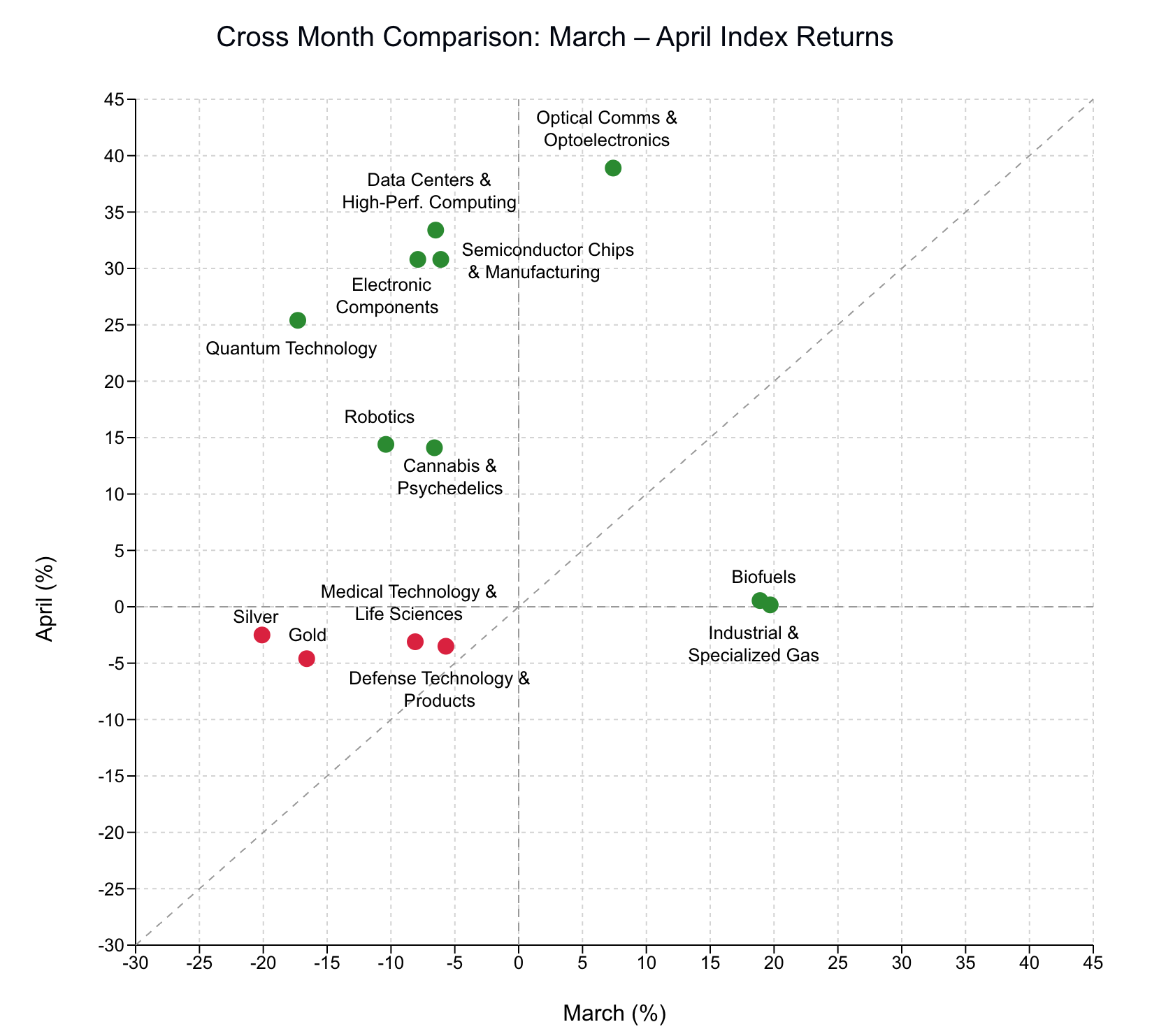
The March-to-April shift was a near-perfect rotation: technology hardware (Semiconductors, Electronic Components, Data Centers) went from worst to first on tariff relief and renewed AI optimism, while Energy themes (Biofuels, Industrial Gas) went from first to flat as ceasefire signals unwound the oil premium. Gold and Silver declined in both months — an unusual failure of the safe-haven playbook suggesting structural selling pressure. Defense Technology persisted as a laggard across both months despite an active conflict, pointing to genuine sector-specific headwinds. Cannabis & Psychedelics showed the sharpest reversal (-6.60% to +14.08%) on policy catalysts, while Quantum Technology's swing from -17.32% to +25.36% highlighted how quickly sentiment shifts in high-beta themes.
Interesting Themes from Cross-Month Comparison
April saw sharp cross-month reversals. Biofuels and Industrial & Specialized Gas collapsed from double-digit March gains to near-flat as ceasefire signals unwound the oil premium. Quantum Technology recovered strongly (+25.36%) on NVIDIA's quantum AI launch and accelerating encryption threat timelines. Silver stabilised but stayed negative. Cannabis & Psychedelics was the standout swing (-6.60% to +14.08%) on cannabis rescheduling and Trump's executive order fast-tracking psychedelic therapies.
Region Best and Worst Performing Themes
Energy dominated regional performance. Oil & Petroleum led across EMEA (+15.45%), US (+13.11%), and APAC-ex-CN (+6.50%) on Hormuz disruption and multi-front supply shocks. Natural & Liquefied Gas (US) gained +12.49% as US producers filled the Qatar supply gap, Coal (EMEA) rose +7.77% on LNG-to-coal fuel switching, and Architecture & Landscaping (CN) gained +5.46% on domestic project activity and data centre construction demand.
On the downside, Copper fell sharply across all regions (APAC-ex-CN -21.56%, CN -21.29%, US -18.58%) on Trump tariffs and Iran-driven demand destruction. Metal & Mineral Mining dropped ~18% in both EMEA and US on iron ore pricing pressure and CATL's sodium-ion battery breakthrough undermining critical mineral demand. Robotics (APAC-ex-CN) fell -22.16%, squeezed between US regulatory restrictions and rapid Chinese competition.
Themes on the Radar
Coherent Optical Pluggables
OFC 2026 (held in Los Angeles in early April) became the inflection point for silicon photonics in AI data centres. Co-packaged optics (CPO) is moving from concept to deployment, with NVIDIA and Broadcom both shipping CPO-based switches built on TSMC's COUPE platform. The "copper wall" — the physical limit of electrical signalling at 224 Gbps — is forcing a structural shift to optical interconnects. Meta presented reliability data at OFC showing CPO outperforms traditional pluggables. Credo's $750M acquisition of DustPhotonics (April 14, 2026) further validates the SiPho/ pluggable category as critical AI infrastructure. CPO is replacing pluggables in scale-out and copper in scale-up — an industry-wide architectural shift.
- SemiEngineering, "All AI Data Center Interconnects Will Be Optical Within 5 Years" (April 2026): Coverage of OFC 2026 in LA; Meta's reliability data on CPO vs. pluggables; NVIDIA's TSMC COUPE deployments.
- Credo Investor Relations, "Credo Agrees to Acquire DustPhotonics" (April 14, 2026): $750M cash + stock acquisition to integrate SiPho PIC technology spanning 400G, 800G, 1.6T pluggables and CPO.
Amylin Analogs and Receptor Agonists
The next-generation obesity drug pipeline is shifting from pure GLP-1 to GLP-1/amylin combinations. Novo Nordisk's amycretin (GLP-1 + amylin agonist) entered Phase 3 in Q1 2026, and CagriSema (cagrilintide + semaglutide) is under FDA review. April 2026 saw a wave of investor commentary debating whether amylin analogs can compete in the GLP-1 era — a clear sign of the theme's emerging status: real candidates, real Phase 3 readouts, but not yet a proven blockbuster category. This is exactly the "gaining traction but not yet a top performer" profile.
- Chemical & Engineering News, "Can amylin weight-loss drugs compete in a world of GLP-1s?" (updated April 10, 2026): Detailed coverage of cagrilintide, Lilly's amylin candidate, and Alveus Therapeutics' weekly amylin-mimicking injectable.
- STAT News, "Researchers behind GLP-1 obesity drugs advance new approach: Drop GLP-1 as a target" (April 23, 2026): Researchers including Richard DiMarchi published peer-reviewed work suggesting amylin-adjacent pathways (GIP/glucagon) could match GLP-1 weight loss without the side effects — a development with direct implications for amylin-class development.
Intelligent Connected Vehicles
Waymo began on-road autonomous testing in London in April 2026 — the first Western metropolis outside the US to host its vehicles, with safety operators behind the wheel ahead of fully driverless rollout. Combined with the planned 20-city expansion (NYC, Tokyo, London) funded by the $16B raise, robotaxis are transitioning from contained pilots to international urban infrastructure. Wayve, Uber, and Nissan also signed a Tokyo pilot agreement targeting late 2026. The theme is on the radar because while Waymo is established, the international expansion phase is genuinely new and the broader robotaxi category (Wayve, Zoox, Tesla, Pony.ai) is just emerging at scale.
- TechCrunch, "London gets closer to its first robotaxi service as Waymo begins testing" (April 14, 2026): Fleet of ~100 Jaguar I-Pace vehicles on London public roads; 100 sq mi test area; commercial launch contingent on UK regulatory approval.
- TipRanks, "Waymo Begins London Road Tests as It Targets 2026 Robotaxi Launch" (mid-April 2026): Coverage of the operational and regulatory ramp.
Commodities Equity Performance Dashboard
This dashboard provides performance analytics for global equities with exposure to commodities-related themes in Theia Insights Industry Classification (TIIC), grouped by Industry (level two).
Regional Thematic Performance Overview (Top and Bottom Performing Themes by Region)
This analysis showcases the top three outperforming and underperforming investment themes across major regions, utilising the Theia Insights Industry Classification (TIIC) framework. By examining how identical themes perform differently across geographical markets, this breakdown illuminates the critical impact of regional economic dynamics, regulatory landscapes, and geopolitical developments on thematic investment returns.
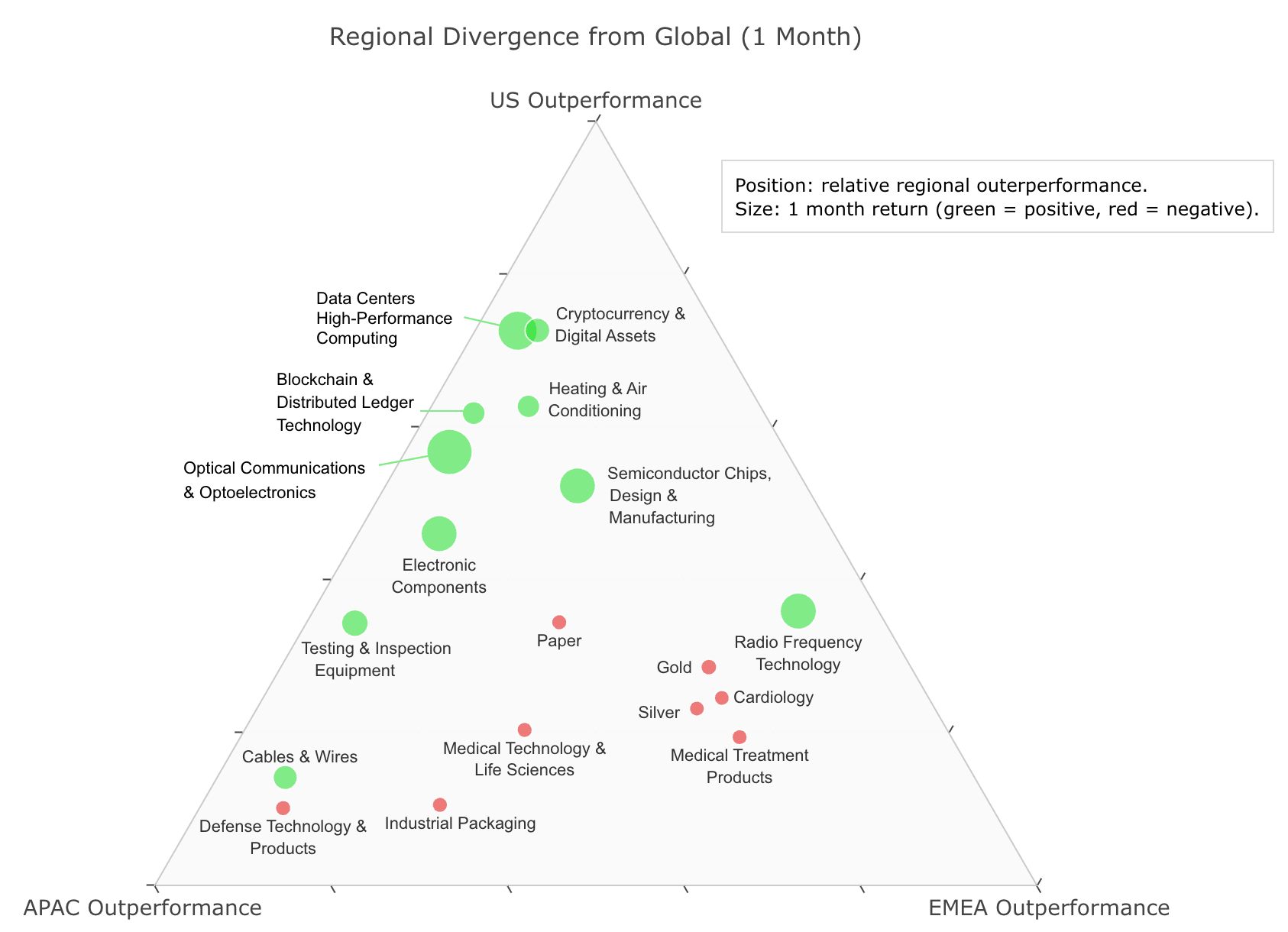
Regional Performance Divergence vs Global
Each point's position indicates the relative regional outperformance compared to the global average. The analysis includes tradable portfolios in all three regions, excluding themes that lack sufficient market presence or liquidity.
Global Sector Thematic Performance (Top and Bottom Performing Themes by Sector)
This dashboard examines thematic investment performance organised by the top-level sectors within the Theia Insights Industry Classification (TIIC) framework. For each sector we report the top three and bottom three performing themes. By grouping themes under their primary sector classifications, this analysis reveals how broad sectoral trends influence underlying thematic opportunities and risks.
Looking Ahead
The US–Iran conflict and the fragility of the ceasefire remain the key macro drivers. Any escalation—such as renewed disruption in the Strait of Hormuz—would likely reignite energy themes, benefiting Oil, Gas, and Biofuels, while sustained de-escalation would shift focus back to Technology Infrastructure. The AI capex cycle remains strong, supporting continued momentum in areas like Semiconductors, Data Centers, and Optical Technologies, especially if trade pressures ease.
Healthcare and Precious Metals continue to face structural headwinds, driven by regulatory uncertainty, tighter insurance dynamics, and disruption from AI in drug development, while Gold and Silver may remain under pressure in a risk-on environment.
Meanwhile, emerging opportunities are forming in Cannabis and Psychedelics due to supportive regulatory shifts, and Quantum Technology is seeing renewed speculative interest—though it remains volatile. Overall, the landscape is shaped by geopolitical uncertainty, a concentrated tech rally, and selective policy-driven upside.