May 2026 Performance Synopsis
May performance was defined by an aggressive rotation into frontier technology, with a 44-percentage-point spread between the best and worst performers. Quantum Technology led all themes at 35.53% — driven by ~$2 billion in US government grants, IBM's spin-off of the first quantum chip foundry, and a series of manufacturing milestones — while Space Exploration (29.71%), Cybersecurity (28.48%), and Data Centers & High-Performance Computing (23.55%) rounded out the top tier on SpaceX's IPO filing at a proposed $1.75 trillion valuation, the first AI-developed zero-day exploit, and Amazon's $200 billion capex commitment respectively. The broader tech stack also participated, with Cloud Computing, Optical Communications & Optoelectronics, and Semiconductor Chips all posting mid-teens returns. The AI infrastructure buildout extended well beyond data centres, supporting semiconductors, optical networking, testing equipment, cables, and data management providers across multiple regions.
The cross-month picture showed both acceleration and sharp reversal. Quantum Technology, Space Exploration, and Cybersecurity dramatically re-rated from single-digit April returns, while Solar Energy reversed from near-flat to 15.18%, supported by growing energy security concerns, accelerating renewable investment, and improving solar economics. Optical Communications & Optoelectronics cooled from April's 39.1% peak but held positive at 16.7%. Regionally, Semiconductor Chips led all three regions, with Cables & Wires topping APAC-ex-CN at 43.07% on Hormuz-driven alternative routing demand and AI data-centre buildout. Semiconductor leadership was broad-based, topping performance tables across APAC-ex-CN, EMEA, and the US as investors responded to major foundry investments, manufacturing milestones, and expanding AI infrastructure demand.
The worst performers reflected a combination of geopolitical disruption, supply-chain pressures, and sector-specific headwinds. Plastics was the steepest decliner at -8.78%, pressured by petrochemical supply disruptions, rising input costs, and broader industry headwinds, while Nuclear Energy fell 7.58% despite strong long-term fundamentals, as concerns around nuclear infrastructure security and geopolitical risk weighed on sentiment. Fruits & Vegetables (-6.88%), Grains & Cereals (-5.22%), and a range of food-processing themes posted broad losses amid weather-related disruptions, inflationary pressures, and concerns over crop yields.
Three themes are on the radar heading into June. The FDA's approval of Arvinas/Pfizer's vepdegestrant — the first authorised PROTAC therapy — marked a first-in-class milestone for Molecular Glue Technology that typically pulls capital toward the whole modality. NextEra's $67 billion all-stock acquisition of Dominion Energy, the largest energy deal this century, crystallised investor focus on Grid Decarbonisation as the buildout required for electrification and AI load growth. And the Strait of Hormuz crisis drew renewed attention to Helium Exploration, Production, Processing, highlighting potential supply-chain risks given Qatar's importance in global high-purity helium production.
Best Performing Themes
May's top performers were overwhelmingly a frontier technology story. Quantum Technology led at 35.53%, driven by ~$2 billion in US government grants and IBM's spin-off of the first quantum chip foundry. Space Exploration surged 29.71% on SpaceX's IPO filing at a proposed $1.75 trillion valuation and the successful Starship V3 test flight. Cybersecurity gained 28.48% as Google confirmed the first AI-developed zero-day exploit and state-sponsored campaigns intensified. Data Centers & High-Performance Computing rose 23.55% on Amazon's $200 billion capex commitment and Anthropic's $15 billion/year SpaceX compute deal. Data Management & Hosting Services gained 20.14%, supported by Anthropic's 80-fold quarterly growth, rising digital sovereignty requirements, and supply constraints benefiting incumbent operators.
Worst Performing Themes
May's worst performers reflected the Iran conflict's supply chain knock-ons and a rotation out of defensives. Plastics fell 8.78% as Strait of Hormuz disruption cut petrochemical feedstock supplies. Nuclear Energy declined 7.58% despite strong long-term fundamentals, as drone strikes on the UAE's Barakah plant and Zaporizhzhia tensions created a risk-off environment. Home & Public Security dropped 7.54% on an ADT customer data breach and Palantir's £50 million Met Police deal being blocked. Domestic Pest Control fell 7.36% as DIY alternatives intensified price competition against professional services. Fruits & Vegetables lost 6.88% amid natural disasters in Florida and Hawaii, Iran war-driven inflation, and India forecasting its weakest monsoon in 11 years.
Cross-Month Comparison
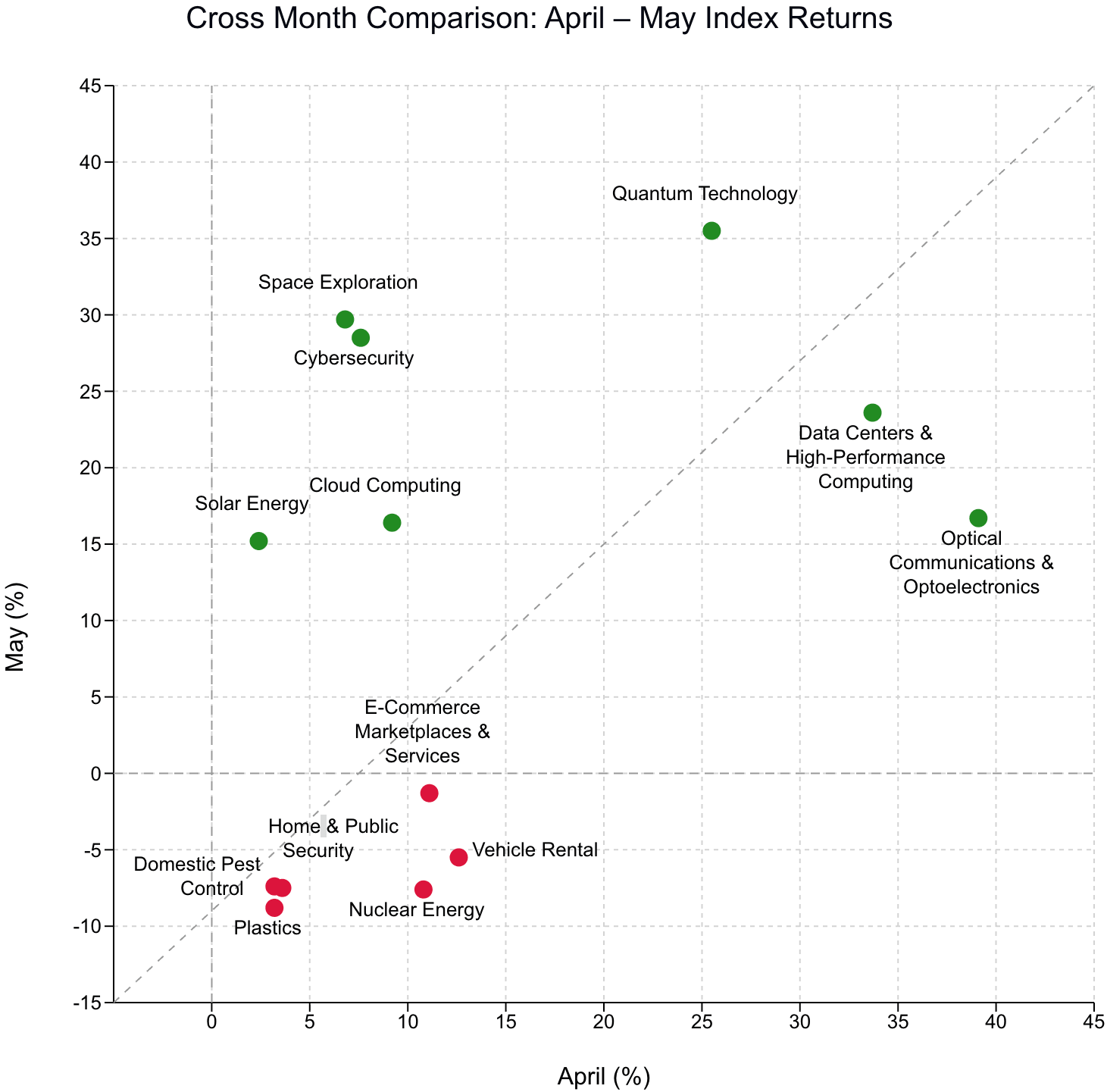
The April-to-May shift was a continuation and acceleration in frontier technology, with Quantum Technology strengthening from 25.5% to 35.5% and Space Exploration and Cybersecurity dramatically re-rating from single digits to 29.7% and 28.5% respectively. Data Centers & High-Performance Computing held at the top in both months, while Optical Communications & Optoelectronics cooled from April's 39.1% peak to 16.7% but remained solidly positive. Within clean energy, Solar Energy reversed from near-flat to 15.2% while Nuclear Energy did the opposite — collapsing from 10.8% to -7.6%. Plastics, Home & Public Security, and Domestic Pest Control each swung from modest positives in April to losses of 7–9% in May, three of the sharpest reversals in the theme universe.
Interesting Themes from Cross-Month Comparison
May saw notable cross-month swings. Solar Energy reversed from near-flat (2.39%) to 15.18% as the Iran conflict accelerated the shift away from fossil fuels and solar overtook coal on the Texas grid. Optical Communications & Optoelectronics decelerated from April's 39.12% to 16.66% but held positive, anchored by Nvidia's Corning deal and Tower Semiconductor's $1.3 billion in silicon photonics contracts. Cloud Computing re-rated from 9.24% to 16.44% on record Q1 cloud infrastructure spending and Anthropic's $200 billion Google Cloud commitment. Vehicle Rental reversed from +12.57% to -5.54% as Airbnb entered the car rental market. E-Commerce Marketplaces & Services flipped from +11.11% to -1.28% on Amazon opening its logistics network and Temu's €200 million EU fine.
Region Best and Worst Performing Themes
Technology hardware dominated regional performance. Semiconductor Chips led all three regions — APAC-ex-CN (+31.19%), EMEA (+29.45%), and US (+33.20%) — on Apple's chip manufacturing agreement with Intel and SpaceX's Terafab announcement. Cables & Wires topped APAC-ex-CN at +43.07% on Hormuz-driven alternative routing demand and AI data-centre buildout. Electronic Components outperformed in CN (+30.36%) and EMEA (+24.36%) on PCB and memory shortages, while Radio Frequency Technology led EMEA at +34.10% on mandatory RFID traceability regulations and HawkEye 360's $416 million IPO.
On the downside, Biofuels fell 6.21% in CN on crude oil weakness and US Renewable Fuel Standard uncertainty. Educational Services & Learning declined 5.99% in CN after a major LMS data breach suspended exams across 8,800+ schools, compounding AI disruption concerns. Architecture & Landscaping fell 5.72% in EMEA as NIMBY opposition to data centre construction and a shift toward lower-margin affordable housing squeezed margins.
Themes on the Radar
Molecular Glue Technology
Molecular Glue Technology had its defining catalyst on May 1, when the FDA approved Arvinas/Pfizer's vepdegestrant (Veppanu) for ESR1-mutated, ER+/HER2- breast cancer. Veppanu is the first authorised PROTAC (proteolysis-targeting chimera) therapy for clinical use, a milestone for the targeted protein degradation field that molecular glues belong to. A first-in-class approval typically pulls capital and pipeline attention toward the whole modality. [458, 459]
Grid Decarbonisation
On May 18, NextEra announced a $67 billion all-stock acquisition of Dominion Energy. The combined entity will lead globally in renewables and battery storage, top the US in natural gas generation, and rank second in nuclear — all framed around meeting AI data-centre power demand. It is the largest energy acquisition this century and would make NextEra the third-biggest US energy company by enterprise value at $420 billion. The deal crystallises investor focus on the decarbonised generation buildout needed for electrification and AI load growth. [460, 461]
Helium Exploration, Production, Processing
Helium is a quiet beneficiary of the Strait of Hormuz crisis: Qatar supplies roughly 30% of global high-purity helium critical to chipmaking, and attacks on its industrial hub are likely to leave supplier Air Liquide unable to fulfil contracts. Analysts have flagged that the helium crisis could haunt AI stocks for months even if the Strait of Hormuz reopens, with the issue surfacing on Linde's Q1 earnings call (May 1). This connects a small, opaque commodity directly to the semiconductor and AI supply chain. [462, 463]
Commodities Equity Performance Dashboard
This dashboard provides performance analytics for global equities with exposure to commodities-related themes in Theia Insights Industry Classification (TIIC), grouped by Industry (level two).
Regional Thematic Performance Overview (Top and Bottom Performing Themes by Region)
This analysis showcases the top three outperforming and underperforming investment themes across major regions, utilising the Theia Insights Industry Classification (TIIC) framework. By examining how identical themes perform differently across geographical markets, this breakdown illuminates the critical impact of regional economic dynamics, regulatory landscapes, and geopolitical developments on thematic investment returns.
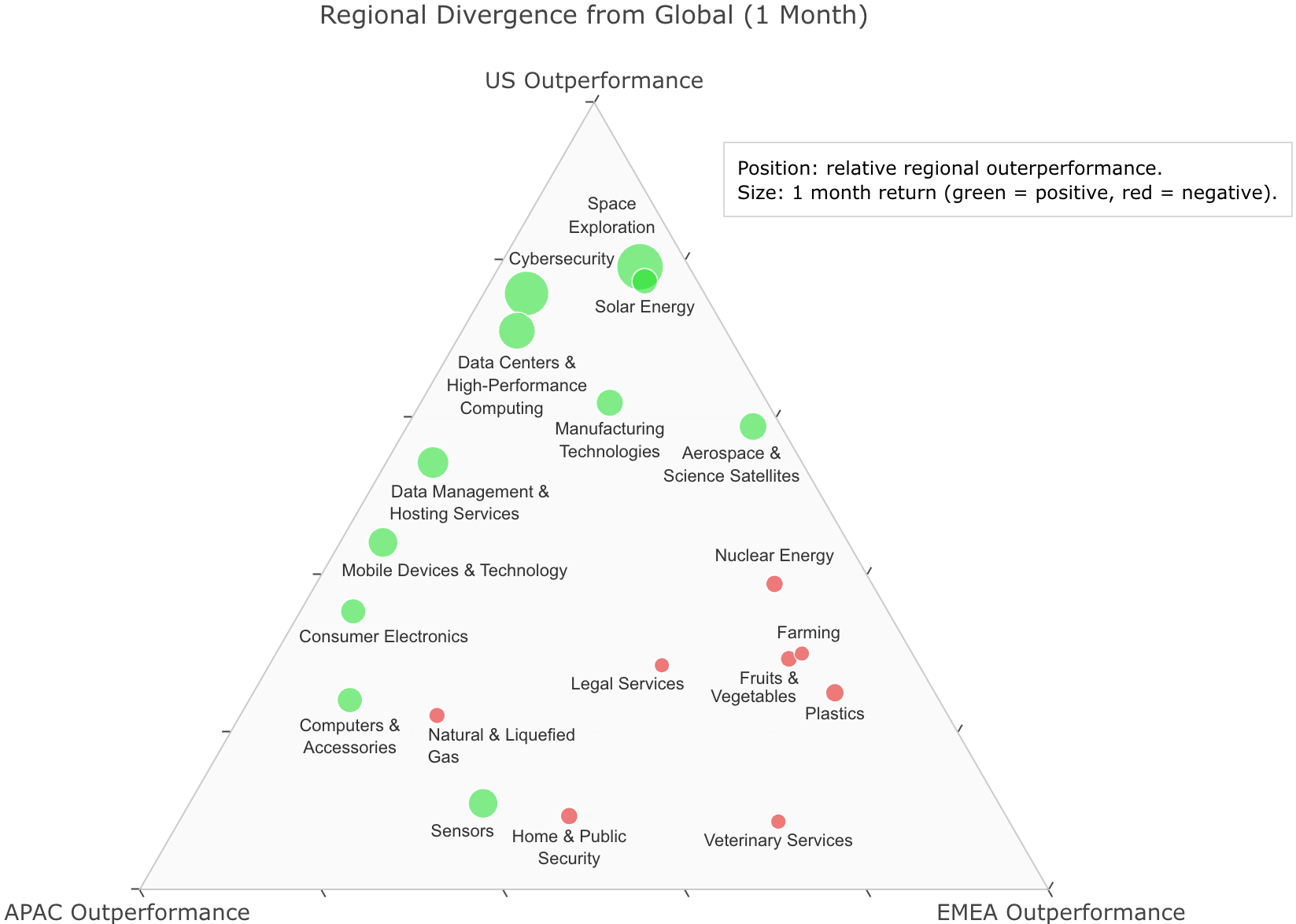
Regional Performance Divergence vs Global
Each point's position indicates the relative regional outperformance compared to the global average. The analysis includes tradable portfolios in all three regions, excluding themes that lack sufficient market presence or liquidity.
Global Sector Thematic Performance (Top and Bottom Performing Themes by Sector)
This dashboard examines thematic investment performance organised by the top-level sectors within the Theia Insights Industry Classification (TIIC) framework. For each sector we report the top three and bottom three performing themes. By grouping themes under their primary sector classifications, this analysis reveals how broad sectoral trends influence underlying thematic opportunities and risks.
Looking Ahead
The Iran conflict and its knock-on effects on commodity supply chains remain the dominant macro risk. Any re-escalation around the Strait of Hormuz could provide support for Oil & Petroleum, Natural & Liquefied Gas, and Biofuels themes, while also amplifying the helium supply squeeze that is quietly threatening semiconductor and AI data centre operations. Conversely, a durable ceasefire and reopened Strait could help ease some of the pressures facing Plastics, Agriculture, and food-linked themes that bore the brunt of May's losses.
The AI infrastructure buildout shows no sign of slowing. Data Centers & High-Performance Computing, Semiconductors, and Optical Communications are all supported by multi-year capital commitments from hyperscalers and governments alike. The SpaceX IPO process—at a proposed $1.75 trillion valuation—could act as a sustained catalyst for Space Exploration and adjacent themes, drawing fresh institutional capital into the sector.
Quantum Technology faces a pivotal test: the extraordinary 35% May return was partly speculative, with intra-month swings of 6–9% on profit-taking. Near-term momentum is supported by the $2 billion US government grant programme and accelerating post-quantum cryptography deadlines, but a consolidation period is plausible. Cybersecurity looks structurally well-positioned given the emergence of AI-developed zero-day exploits and intensifying state-sponsored campaign activity.
Nuclear Energy's sharp reversal from April's gains—driven by drone attacks on the UAE's Barakah plant and Zaporizhzhia tensions—may prove temporary if geopolitical risks around nuclear infrastructure stabilise. The long-term demand narrative from AI data centre power consumption remains intact, and analyst conviction remains high.
Emerging themes worth monitoring include Grid Decarbonisation (crystallised by the NextEra–Dominion $67 billion merger), Molecular Glue Technology (following the first PROTAC FDA approval for breast cancer), and Helium Exploration & Production as a latent supply-chain risk for the entire semiconductor and AI ecosystem.