July delivered a dramatic divergence across thematic portfolios, with a roughly 54-percentage-point spread between the best and worst performers signalling a clear rotation out of hardware-intensive technology and industrials into services and workforce themes. Staffing Services led at 26.21%, followed by Human Resources at 24.26% and Accounting & Auditing at 18.77%, as investors favoured asset-light, cash-generative business models. Business Consultancy (17.68%) and Motorcycles (17.44%) rounded out the top five, while software and cloud names such as Digital Transformation and Software Development & Solutions also rebounded strongly.
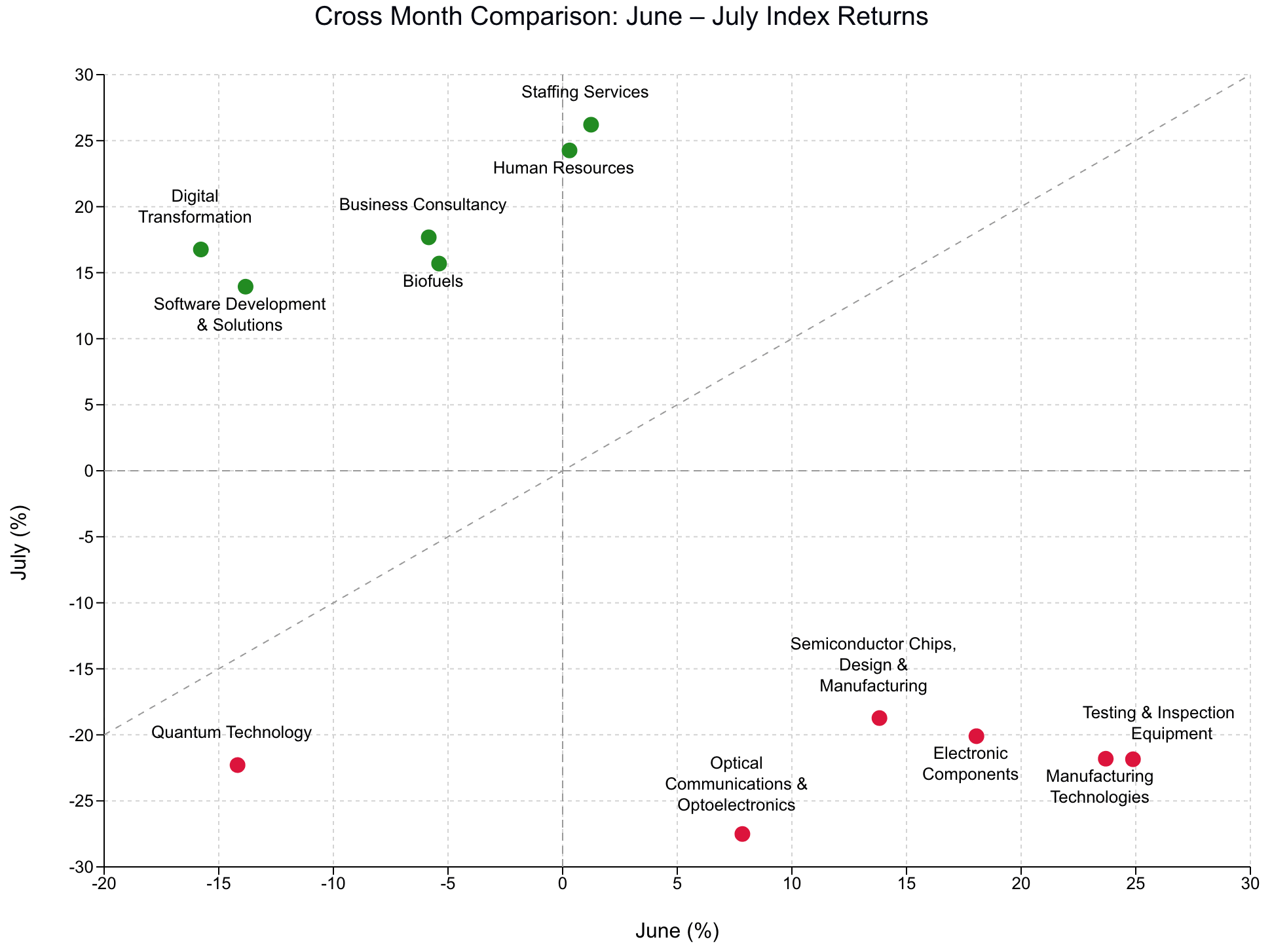
The cross-month picture was defined by violent reversals. Semiconductor Chips, Design & Manufacturing, Electronic Components and Testing & Inspection Equipment round-tripped their June gains, while Digital Transformation (June -15.78% to July +16.76%) and Software Development & Solutions (-13.83% to +13.94%) swung from loss to gain, and Staffing Services accelerated from a flat June to lead the month. Regionally, E-Cigarettes (+20.22% in APAC-ex-CN), Gold (+16.03% in CN) and Tobacco (+14.17% in APAC-ex-CN) led, while Surface Technologies (-39.02% in CN), Fibers (-27.99% in APAC-ex-CN) and Optics & Glass Products (-27.66% in the US) lagged.
The heaviest losses hit hardware and speculative frontier technology. Optical Communications & Optoelectronics collapsed 27.51% as the AI-optics trade cooled, Quantum Technology fell 22.29% on a classical-computing breakthrough and an IBM earnings miss, and the semiconductor-equipment complex—Manufacturing Technologies (-21.81%) and Testing & Inspection Equipment (-21.85%)—unwound sharply. Electronic Components dropped 20.10% on a Japanese earthquake supply shock and fresh China AI-competition fears, while Semiconductor Chips, Design & Manufacturing fell 18.73% on reports of a Chinese lithography breakthrough and an SK Hynix earnings miss.
The same de-risking wave caught the space frontier, with Space Exploration down 13.07% and Aerospace & Science Satellites off 13.54% as investors reassessed valuations for companies with distant profitability timelines, and Cryptocurrency & Digital Assets slipped 4.99%, though that fall was relatively contained. Financials were broadly positive—Insurance Support & Insurtech (7.19%), Financial Advisory & Tax (7.04%) and Digital Banking (7.03%)—while real estate was mixed, with Real Estate Investment eking out 2.77% as Residential Real Estate fell 6.03% on elevated borrowing costs.
Away from the extremes, consumer and health themes posted modest but positive returns in the low-to-mid single digits. Packaged & Processed Foods gained 4.75% and Veterinary Services added 5.30%, while health names such as Medical Equipment (8.60%) and Hospitals (6.12%) delivered steady, defensive performance. Transportation also surprised on the upside, with Bicycles up 11.75% on idiosyncratic catalysts and seasonal demand rather than any broad discretionary rally.
Three themes are on the radar heading into August: deep-sea polymetallic nodule activities, as a July decision window sharpened the seabed-governance timeline; retinal and cortical visual prosthesis, on the European commercial launch of Science Corp's PRIMA implant; and enrichment operations, technology and capacity, on Centrus' $900m DOE award and Urenco USA's cascade expansion.
Best Performing Themes
July's leaders were overwhelmingly a human-capital and professional-services story. Staffing Services led at 26.21% on ManpowerGroup's blowout Q2 earnings and a broad recovery in placement demand, while Human Resources (24.26%) rode a wave of tech layoffs and AI-reshaped recruiting. Accounting & Auditing (18.77%) gained on AI-efficiency hopes and rising regulatory demand, Business Consultancy (17.68%) on a bullish sector outlook and landmark M&A, and Motorcycles (17.44%) on new launches and a strong racing season.
Worst Performing Themes
July's losers were concentrated in hardware and speculative technology. Optical Communications & Optoelectronics fell 27.51% as the AI-optics trade cooled and capacity-expansion oversupply fears mounted, and Quantum Technology (-22.29%) slid on a classical-computing breakthrough and an IBM earnings miss. The semiconductor-equipment complex unwound, with Testing & Inspection Equipment (-21.85%) and Manufacturing Technologies (-21.81%) both reversing, while Electronic Components (-20.10%) fell on a Japan earthquake supply shock and China AI-competition fears.
Cross-Month Comparison
July marked a decisive rotation out of hardware-intensive technology and industrials and into services and workforce themes. June's leaders—Semiconductor Chips, Design & Manufacturing, Electronic Components and Testing & Inspection Equipment—round-tripped their gains, while Digital Transformation, Software Development & Solutions and Biofuels reversed June losses into strong July gains and Staffing Services and Human Resources accelerated from a flat June to lead the month.
Interesting Themes from Cross-Month Comparison
The sharpest reversals were Digital Transformation (June -15.78% to July +16.76%) and Software Development & Solutions (-13.83% to +13.94%), both rebounding on a cluster of frontier model releases and cheaper AI, while Semiconductor Chips, Design & Manufacturing (+13.82% to -18.73%) collapsed on a Chinese lithography breakthrough and an Asian chip sell-off, and Biofuels (-5.39% to +15.69%) rallied on record US mandates and global blending expansion.
Region Best and Worst Performing Themes
Nicotine and precious-metals themes led the regional tables. E-Cigarettes topped at 20.22% in APAC-ex-CN on resilient demand despite regulatory bans, Gold rose 16.03% in CN on record Chinese accumulation, and Tobacco gained 14.17% in APAC-ex-CN on the FDA's ZYN reduced-risk decision. On the downside, Surface Technologies fell 39.02% in CN on broad Chinese-market weakness, Fibers dropped 27.99% in APAC-ex-CN on Chinese carbon-fibre overcapacity, and Optics & Glass Products lost 27.66% in the US as value shifted towards silicon photonics.
Themes on the Radar
Deep Sea Polymetallic Nodule Activities
July was the decision window for seabed governance. The International Tribunal for the Law of the Sea rejected the TMC subsidiaries' bid to suspend the ISA's non-compliance inquiry, while ordering the regulator to explain the factual and legal basis of that inquiry and give NORI and TOML a meaningful opportunity to respond; both sides must report on compliance by 31 August, and the ISA Assembly was set to convene 27–31 July. The timing matters because NORI's exploration licence in the Clarion-Clipperton Zone was due to expire on 21 July and is up for review — and if member governments cancel it, competing applicants could move on the area, which would in turn complicate TMC USA's parallel application under the US permitting route. The unresolved question of whether the multilateral regime or the US DSHMRA pathway governs commercial recovery is now a datable binary for anyone with CCZ exposure. [290, 291]
Retinal and Cortical Visual Prosthesis
A first-in-class commercialisation event that has had almost no factor-level attention. Science Corp announced the European commercial launch of PRIMA, the first brain-computer-interface device to receive CE marking for form vision restoration — reading letters, numbers and words — with 80% of patients achieving prosthetic visual acuity improvements of at least 0.2 logMAR at 12 months (p<0.001), and no decline in mean existing natural vision. Country-specific reimbursement applications and clinical site activations are underway, with the first commercial implant expected shortly in Germany. Coverage of the approval focused on the US timeline, even though European regulators have now cleared commercial sale of an implant that improves central vision in age-related macular degeneration patients. This moves visual prosthesis from a research-stage curiosity to a reimbursable product class. [292, 293]
Enrichment Operations, Technology, Capacity
The nuclear fuel bottleneck converted into contracted capex this month. Centrus signed the contract finalising the terms of a competitively awarded $900m DOE task order on 1 July, supporting deployment of large-scale production capacity for HALEU as part of a multi-billion-dollar expansion that also covers LEU; the company completed the final 900 kg of HALEU UF6 required under the prior demonstration contract in mid-June, two weeks ahead of schedule, taking cumulative output past 1,900 kg. In parallel, Urenco USA added a fifth enrichment cascade at its National Enrichment Facility in Eunice, New Mexico, part of a programme to install 700,000 SWU over two years including three further cascades by early 2027, alongside a separate plan to expand the site's capacity by roughly 50%. This is the upstream complement to the advanced reactor themes and arguably the more investable leg, since fuel availability — not reactor design — is the binding constraint. [294, 295]
Commodities Equity Performance Dashboard
This dashboard provides performance analytics for global equities with exposure to commodities-related themes in Theia Insights Industry Classification (TIIC), grouped by Industry (level two).
Regional Thematic Performance Overview (Top and Bottom Performing Themes by Region)
This analysis showcases the top three outperforming and underperforming investment themes across major regions, utilising the TIIC framework. By examining how identical themes perform differently across geographical markets, this breakdown illuminates the critical impact of regional economic dynamics, regulatory landscapes and geopolitical developments on thematic investment returns.
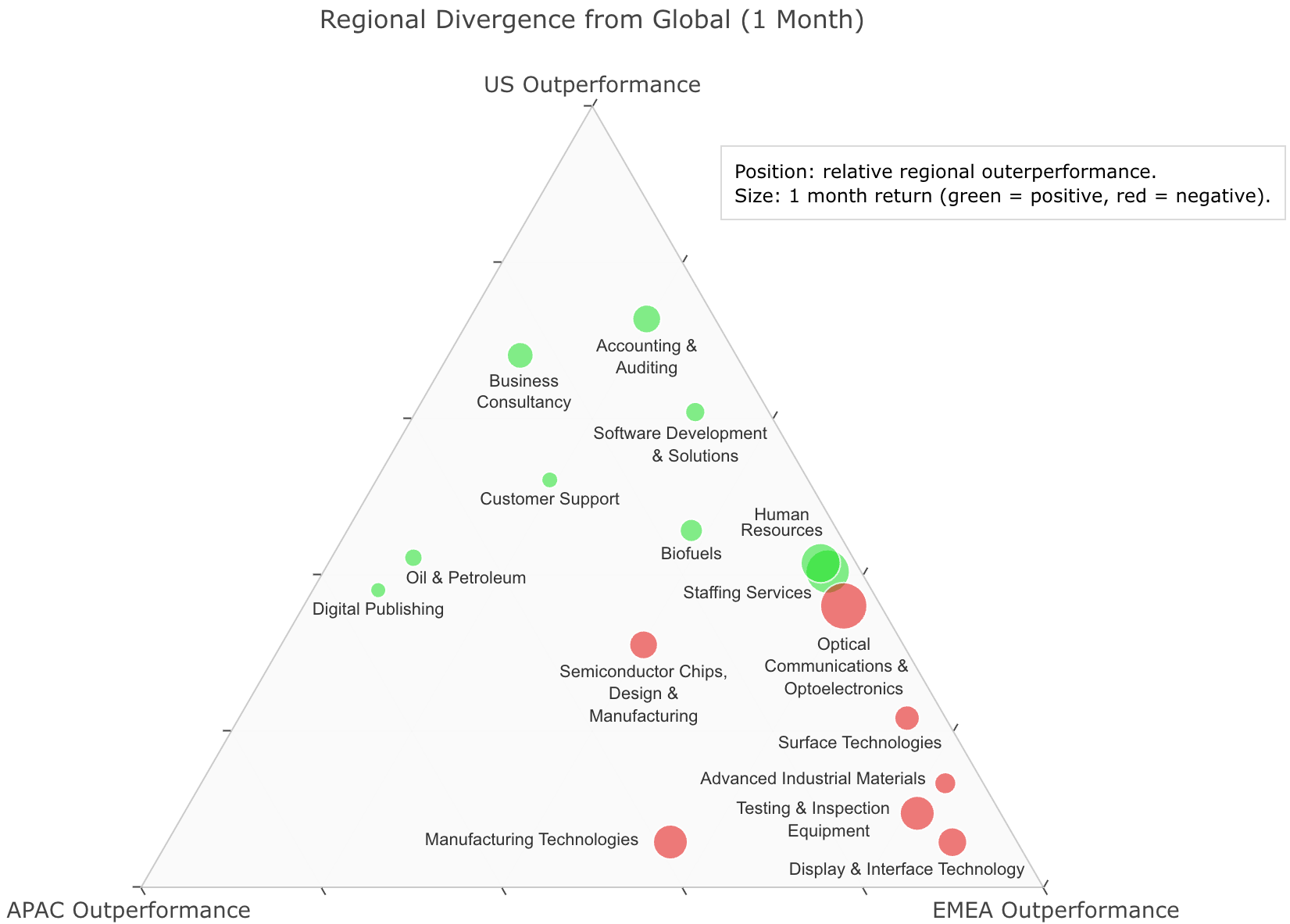
Regional Performance Divergence vs Global
Each point's position indicates the relative regional outperformance compared to the global average. The analysis includes tradable portfolios in all three regions, excluding themes that lack sufficient market presence or liquidity.
Global Sector Thematic Performance (Top and Bottom Performing Themes by Sector)
This dashboard examines thematic investment performance organised by the top-level sectors within the TIIC framework. For each sector we report the top three and bottom three performing themes. By grouping themes under their primary sector classifications, this analysis reveals how broad sectoral trends influence underlying thematic opportunities and risks.
Looking Ahead
July's rotation into services and workforce themes reflects a market favouring asset-light, cash-generative businesses over capital-intensive AI-infrastructure plays. Staffing Services, Human Resources and Business Consultancy are underpinned by a resilient labour market and enterprise AI-transformation spending, while the software and digital-transformation rebound suggests June's sell-off was overdone. Energy's tilt back towards hydrocarbons over renewables is the other trend to watch.
The hardware complex remains the swing factor. Optical Communications & Optoelectronics, Semiconductor Chips, Design & Manufacturing, Electronic Components and Testing & Inspection Equipment all unwound sharply in July, and whether they stabilise or extend their declines will shape the coming month. Deep-sea polymetallic nodule activities, retinal and cortical visual prosthesis, and enrichment operations are the emerging themes worth monitoring, tied to the critical-minerals, medical-device and nuclear-fuel buildouts respectively.
Onthos is a deep tech company building the common ontology for global financial markets. Founded in Cambridge, Onthos combines proprietary AI, natural language processing, quantitative modelling and knowledge graph architecture to translate diverse sources of corporate and financial signals into a living map of the economy.
Used by leading index providers, asset managers, hedge funds, banks and fintech platforms, Onthos’ structural intelligence layer enables consistent, auditable and economically grounded decision-making across teams, systems and, increasingly, AI workflows.
Our name draws on the Greek ὄν, ὄντος, ‘that which is’. It reflects our mission: to make visible the underlying structure of the global economy.