August 2026 Performance Synopsis
Precious metals and mining swept August, opening a roughly 35-percentage-point spread between the best and worst thematic portfolios. Silver led at 26.91% and Gold followed at 24.99%, with Metal & Mineral Mining at 20.86% as gold miners posted their strongest month on record. Staffing Services (19.79%) and Coal (19.61%) completed the top five. The rally was concentrated rather than universal: Copper gained 17.27% and Nickel 13.25%, but Iron & Steel managed 5.56%, Titanium 3.12% and Aluminum just 0.90%—a precious and select-industrial metals story, not a commodities supercycle.
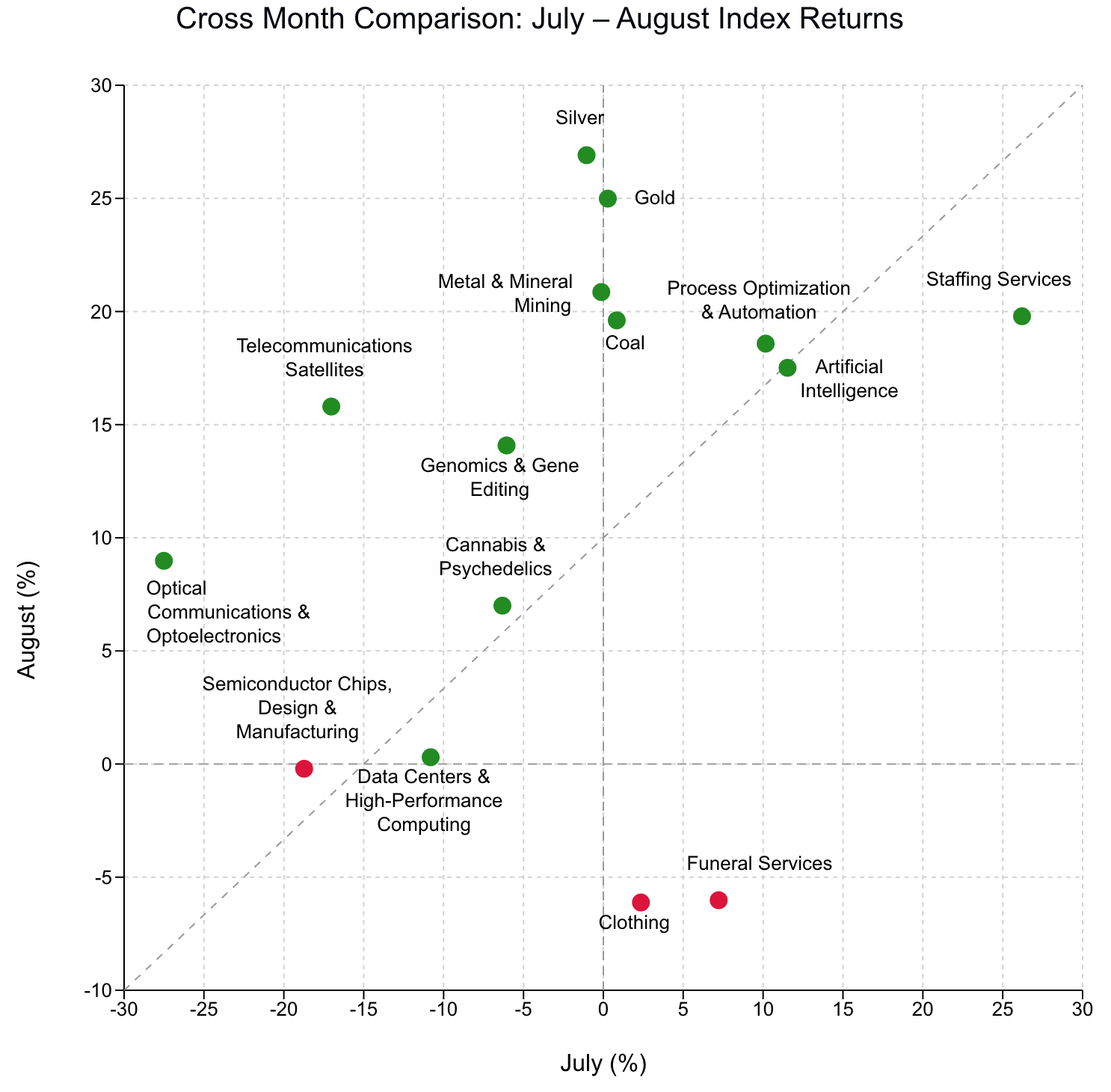
The cross-month picture was one of violent mean reversion. Silver swung from -1.05% in July to 26.91%, Gold from 0.28% to 24.99% and Metal & Mineral Mining from -0.13% to 20.86%, while Telecommunications Satellites (-17.03% to 15.80%) and Optical Communications & Optoelectronics (-27.51% to 8.98%) round-tripped July's losses. The AI trade split cleanly down the middle: Artificial Intelligence accelerated to 17.51% and Process Optimization & Automation to 18.58%, while Semiconductor Chips, Design & Manufacturing (-0.21%) and Data Centers & High-Performance Computing (0.30%) stayed flat—investors paying for AI applications, not AI infrastructure. Regionally, Fibers led at 37.30% in APAC-ex-CN, ahead of Testing & Inspection Equipment (23.33%) and Porcelain & Ceramics (23.12%) in CN, while Vehicle Rental fell 10.57% in EMEA and Luxury Fashion & Accessories 9.96% in the US.
The losses landed on consumer-facing and cyclical themes. Air Transport & Charter Services was worst at -8.29% on an airline failure, projected Middle East carrier losses and softer air freight, while Tourism & Travel Services (-5.77%) absorbed a 25.4% collapse in Canadian travel to the US and war-disrupted European holidays. Clothing (-6.12%) fell on Shein's shrunken IPO valuation and Nike's stalled turnaround, and Funeral Services (-6.02%) reversed July's gain. Heating & Air Conditioning (-5.43%) was squeezed by a mini-split price war. Renewables had a poor month against strength in traditional energy—Wind Energy -3.61%, Solar Energy -2.80% and Non-Solar Renewable Energy -2.11%, against Nuclear Energy at 7.63% and Oil & Petroleum at 4.50%.
Three themes are on the radar heading into September: Black Mass Processing, Concentration, Spreading, after a Defense Production Act order forced US sellers to allocate all monthly sales domestically; Indium Phosphide Material and Technology, where the laser supply gap now exceeds the memory shortfall; and Peaking Capacity and Generation Management, with gas-turbine slots sold out to 2031 and PJM's auction clearing at its cap for a third year.
Best Performing Themes
August's leaders were a precious-metals and mining story. Silver led at 26.91%, recovering part of its drawdown from January's ~$121/oz peak as soft US inflation data weakened the dollar and Citi held a $90 target. Gold (24.99%) rode Iran and Strait of Hormuz tensions plus the Treasury's expanded long-dated buybacks, and Metal & Mineral Mining (20.86%) captured a record 43% month for gold miners alongside record copper prices. Staffing Services (19.79%) gained on Q2 beats from HireQuest and TrueBlue, and Coal (19.61%) on war-driven energy prices and a 25% jump in coking-coal prices.
Worst Performing Themes
August's losers were concentrated in travel, consumer discretionary and cyclicals. Air Transport & Charter Services fell 8.29% as an airline halted operations, IATA projected a $4.3bn loss for Middle East carriers and eVTOL players pivoted towards defence. Clothing (-6.12%) was dragged down by Shein's sub-$30bn IPO pricing, and Funeral Services (-6.02%) slipped on alternative disposition methods and sector rotation. Tourism & Travel Services (-5.77%) lost Canadian visitors and European summer bookings, while Heating & Air Conditioning (-5.43%) faced sub-$400 mini-split pricing and DIY heat-pump disruption.
Cross-Month Comparison
August was defined by mean reversion into hard assets. Silver, Gold and Metal & Mineral Mining all went from roughly flat or negative July returns to 20%-plus gains, and Coal from 0.84% to 19.61%. Telecommunications Satellites and Optical Communications & Optoelectronics bounced back from steep July drawdowns, while Staffing Services held its lead across both months. The hardware complex was the exception: Semiconductor Chips, Design & Manufacturing and Data Centers & High-Performance Computing sold off hard in July and never recovered, even as AI software and automation themes accelerated.
Interesting Themes from Cross-Month Comparison
The sharpest reversals were Optical Communications & Optoelectronics (July -27.51% to August 8.98%), lifted by a proposed US ban on Chinese optical transceivers, and Telecommunications Satellites (-17.03% to 15.80%) on SpaceX's debut results and sovereign constellation spending. Semiconductor Chips, Design & Manufacturing stayed flat at -0.21% after July's 18.73% fall, a stabilisation rather than a rebound, while Artificial Intelligence (11.53% to 17.51%) and Process Optimization & Automation (10.16% to 18.58%) both accelerated.
Region Best and Worst Performing Themes
Materials and industrials led the regional tables. Fibers topped at 37.30% in APAC-ex-CN as British wool prices rose more than 70% year on year, while Testing & Inspection Equipment gained 23.33% and Porcelain & Ceramics 23.12% in CN—the latter on the UNESCO World Heritage inscription of Jingdezhen's porcelain sites. On the downside, Vehicle Rental fell 10.57% in EMEA after Pershing Square exited Hertz, Luxury Fashion & Accessories lost 9.96% in the US on LVMH's Patou divestment and mass store closures, and Food Processing Equipment declined 6.89% in the US on Middleby's separation.
Themes on the Radar
Black Mass Processing, Concentration, Spreading
The intermediate powder from shredded lithium-ion batteries went from a traded commodity to a controlled strategic material almost overnight. On 6 August, BIS published a temporary final rule under the Defense Production Act requiring US sellers of black mass to allocate 100% of monthly sales domestically, effective 27 August 2026 and running for a year. With US black mass exports at roughly 100,000 tonnes in 2025 and North America short of pCAM and CAM capacity, the rule forces a rapid domestic build-out of hydro- and pyro-metallurgical refining—a structural demand shift for a niche that had been valued mainly as a feedstock exporter. [327, 328]
Indium Phosphide Material and Technology
Silicon can guide and modulate light but cannot generate it, so every silicon photonics platform in production still needs an InP laser in the package. Lumentum's management has put the demand–supply gap above 30%, arguing it now exceeds the DRAM and NAND shortfall, as orders shift from hundreds of telecom units to hundreds of millions for hyperscale 800G and 1.6T optics. Supply is constrained across substrates, epitaxy, qualified lines and yields, and is further exposed to Chinese indium export licensing. This is a classic second-order AI bottleneck: small, unglamorous and suddenly load-bearing. [329, 330]
Peaking Capacity and Generation Management
Heavy-duty gas turbine slots are now selling for 2031 delivery, with GE Vernova's backlog and slot reservations at 116 GW and global Q2 orders at a record 38 GW against 60–70 GW of annual manufacturing capacity. PJM's July auction cleared at its price cap for a third consecutive year, finished 6,831 MW short of its reliability requirement and attracted just 525 MW of new generation. The gap is being filled by fast-deploying peaking and onsite assets—reciprocating engines, simple-cycle units and behind-the-meter power systems—rather than by new combined-cycle plant. ERock's Q2 results, including a 470 MW order from Anthropic, illustrate how quickly that order book is repricing. [331, 332]
Commodities Equity Performance Dashboard
This dashboard provides performance analytics for global equities with exposure to commodities-related themes in Theia Insights Industry Classification (TIIC), grouped by Industry (level two).
Regional Thematic Performance Overview (Top and Bottom Performing Themes by Region)
This analysis showcases the top three outperforming and underperforming investment themes across major regions, utilising the TIIC framework. By examining how identical themes perform differently across geographical markets, this breakdown illuminates the critical impact of regional economic dynamics, regulatory landscapes and geopolitical developments on thematic investment returns.
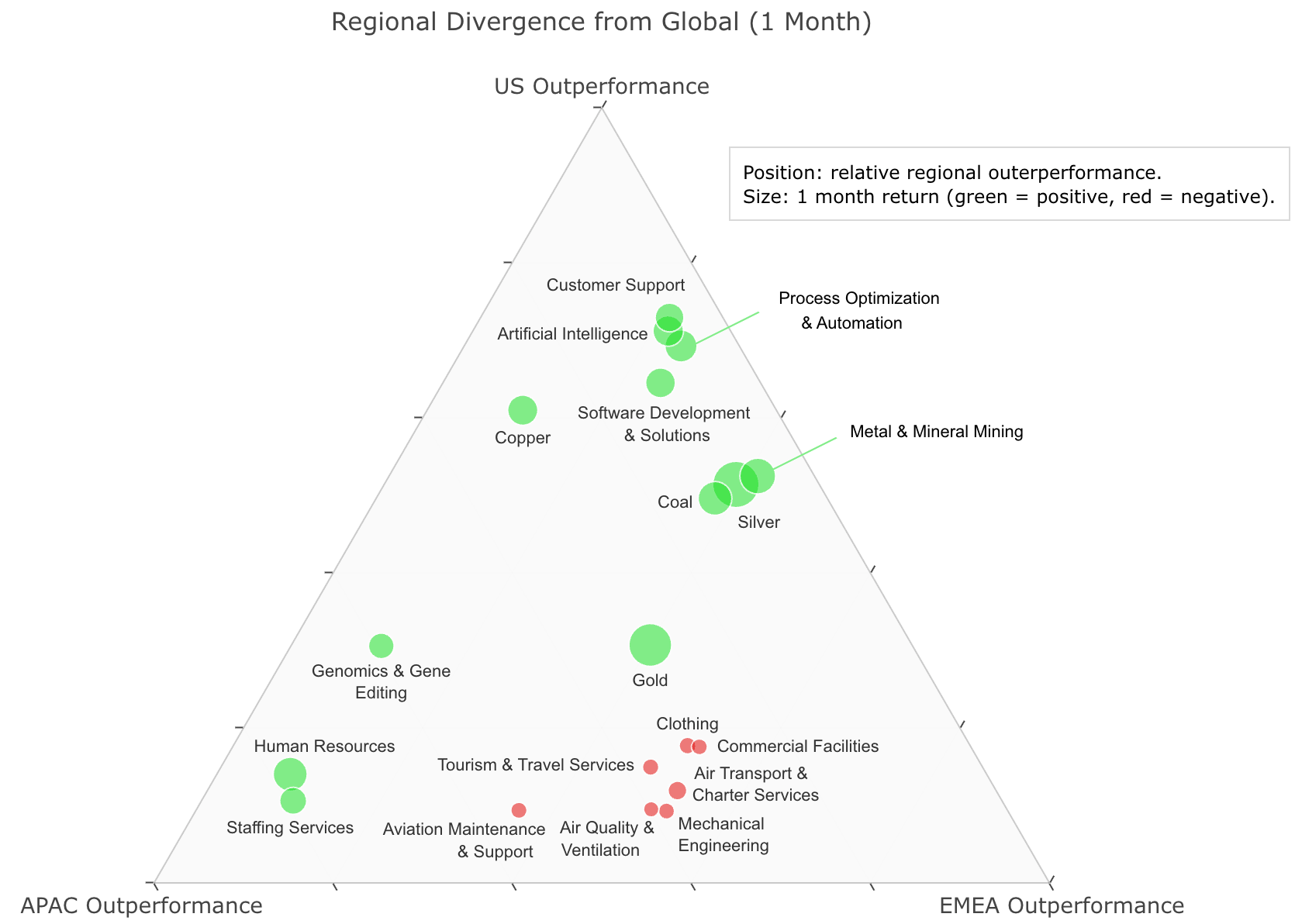
Regional Performance Divergence vs Global
Each point's position indicates the relative regional outperformance compared to the global average. The analysis includes tradable portfolios in all three regions, excluding themes that lack sufficient market presence or liquidity.
Global Sector Thematic Performance (Top and Bottom Performing Themes by Sector)
This dashboard examines thematic investment performance organised by the top-level sectors within the TIIC framework. For each sector we report the top three and bottom three performing themes. By grouping themes under their primary sector classifications, this analysis reveals how broad sectoral trends influence underlying thematic opportunities and risks.
Looking Ahead
August's rotation into precious metals and mining reflects a market hedging currency debasement and fiscal risk rather than betting on growth. The Treasury's expanded long-dated buybacks, a softer dollar and unresolved Iran tensions underpinned Silver, Gold and Metal & Mineral Mining, and whether that holds depends on how hawkish the Fed proves under Chair Warsh. Coal's revival and nuclear's steady gains against a weak renewables complex are the other trend to watch.
The AI split is the swing factor. Artificial Intelligence, Process Optimization & Automation and Software Development & Solutions all accelerated while Semiconductor Chips, Design & Manufacturing and Data Centers & High-Performance Computing stayed flat, and whether the capex-heavy side re-rates or continues to lag will shape the coming month. Black Mass Processing, Indium Phosphide, and Peaking Capacity and Generation Management are the emerging themes worth monitoring, tied to the critical-minerals, optical-component and power-constraint build-outs respectively.